England Women’s National Cricket Team: Top Players & Squad
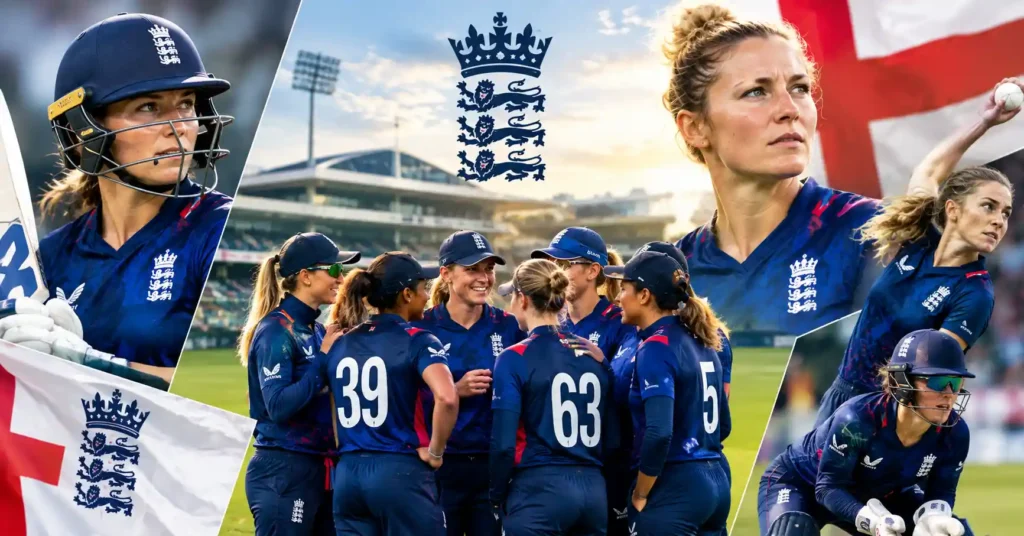
The England women’s national cricket team represents England in international women’s cricket. The team plays Tests, One Day Internationals (ODIs), and T20 Internationals (T20Is). England have a long history in women’s cricket. The team has won major events and produced many famous players. This guide covers the England women’s cricket team, players, squad, captain, coach, results, World Cup history, and recent changes. England Women’s Cricket Team The England women cricket team is one of the major teams in international cricket. England play against Australia, India, New Zealand, South Africa, and the West Indies. The team plays home and away series throughout the year. England also compete in the women cricket World Cup, T20 World Cups, and other major events. England Women’s Cricket Players The England women’s cricket players have different roles. Some are batters, some are bowlers, while others are all-rounders or wicketkeepers. Recent England players include: The squad can change because of form, injury, workload, or retirement. England Women’s Cricket Team Players The England women’s cricket team players bring different skills to the side. Nat Sciver-Brunt is an all-rounder and one of the team’s main leaders. Sophie Ecclestone is a key spin bowler. Lauren Bell and Lauren Filer are pace options. Amy Jones is an experienced wicketkeeper. Danni Wyatt-Hodge is a powerful batter who can score quickly in T20 cricket. England Women’s Cricket Team Top Players The England women’s cricket team top players include Sciver-Brunt, Ecclestone, Beaumont, Knight, and Wyatt-Hodge. At the 2026 T20 World Cup, Wyatt-Hodge scored 302 runs and finished as the tournament’s leading run-scorer. Sciver-Brunt also played a major role in England reaching the final. (ICC) England Women’s National Cricket Team Players The England women’s national cricket team players have changed over time. Two major players recently announced their retirement from international cricket. Tammy Beaumont retired from international cricket in July 2026. She made 260 appearances for England and scored 12 ODI centuries. She was also Player of the Tournament when England won the 2017 Women’s World Cup. (ECB) Heather Knight also announced her retirement in July 2026. She played 320 matches for England and led England as captain 199 times. She was captain when England achieved their 2017 World Cup win. (ECB) England Women Cricket Squad The England women cricket squad can change for every series. Test, ODI, and T20I squads may have different players. This gives selectors more options and helps manage player workloads. England also use central contracts to support their leading players. The ECB announced 17 full England Women’s Central Contracts and four Skills Contracts for 2025/26. (ECB) England Women’s Cricket Team Squad The England women’s cricket team squad includes experienced players and younger talent. The team continues to give opportunities to new players. This is important after the recent retirement of senior players. Fans should check the latest squad before an England women cricket match, as selections can change. England Women’s Cricket Team Captain The England women’s cricket team captain at the 2026 T20 World Cup was Nat Sciver-Brunt. She led England to the final after England beat South Africa in the semi-final. Sciver-Brunt scored 75 in that match. England then played Australia in the final at Lord’s. Australia won by seven wickets. (ICC) Captaincy can change between formats. Charlie Dean, for example, captained England in the ODI series against Ireland in September 2026. England Women’s Cricket Team Coach The England women’s cricket team coach is Charlotte Edwards. Edwards is a former England captain and an important figure in the women’s game. She previously led England as a player. She now works with a new group of England players and helps prepare the team for major international competitions. Women Cricket World Cup History England have a strong history in the women cricket world cup. One of the biggest moments came in 2017. England hosted and won the Women’s Cricket World Cup. Heather Knight was captain, while Tammy Beaumont was named Player of the Tournament. Beaumont scored 410 runs during the competition. The 2017 World Cup win remains one of the most important achievements in England women’s cricket. For historical information, readers may also find pages on Wikipedia, the free encyclopedia. However, official ECB and ICC pages are better for current squad and match information. England Women’s Cricket Team Results The England women’s cricket team results include Tests, ODIs, T20Is, and World Cup matches. In the 2026 Women’s T20 World Cup, England reached the final. They beat South Africa in the semi-final before losing to Australia in the final. This was a strong tournament run, even though England did not win the final. England Women Cricket Match An England women cricket match can be a Test, ODI, or T20I. A Test is the longest format. An ODI has 50 overs per side, while a T20I has 20 overs per side. England also played India in a historic women’s Test match at Lord’s in July 2026. England Women’s Cricket Team Batting Order The England women’s cricket team batting order can change from match to match. Opening batters usually face the new ball. Middle-order players then build the innings or increase the scoring rate. Players such as Tammy Beaumont, Danni Wyatt-Hodge, Nat Sciver-Brunt, and Heather Knight have all played important batting roles for England. England Players and Future The England team is now entering a new period. Experienced players have retired, while younger players are getting more chances. The aim is to build a strong team for future ICC events. Players such as Sciver-Brunt, Ecclestone, Dean, Jones, and Wyatt-Hodge provide experience, while new talent continues to develop. The future of England women cricket will depend on how well this mix of experience and youth develops. Frequently Asked Questions Who is the England women’s cricket team captain? Nat Sciver-Brunt was captain of England at the 2026 T20 World Cup. Who is the England women’s cricket team coach? Charlotte Edwards is the England women’s cricket team coach. Who are the England women’s cricket team top players? Nat Sciver-Brunt, Sophie Ecclestone, Charlie Dean, Amy Jones, and
New Zealand Women: 7 Amazing Facts About the White Ferns
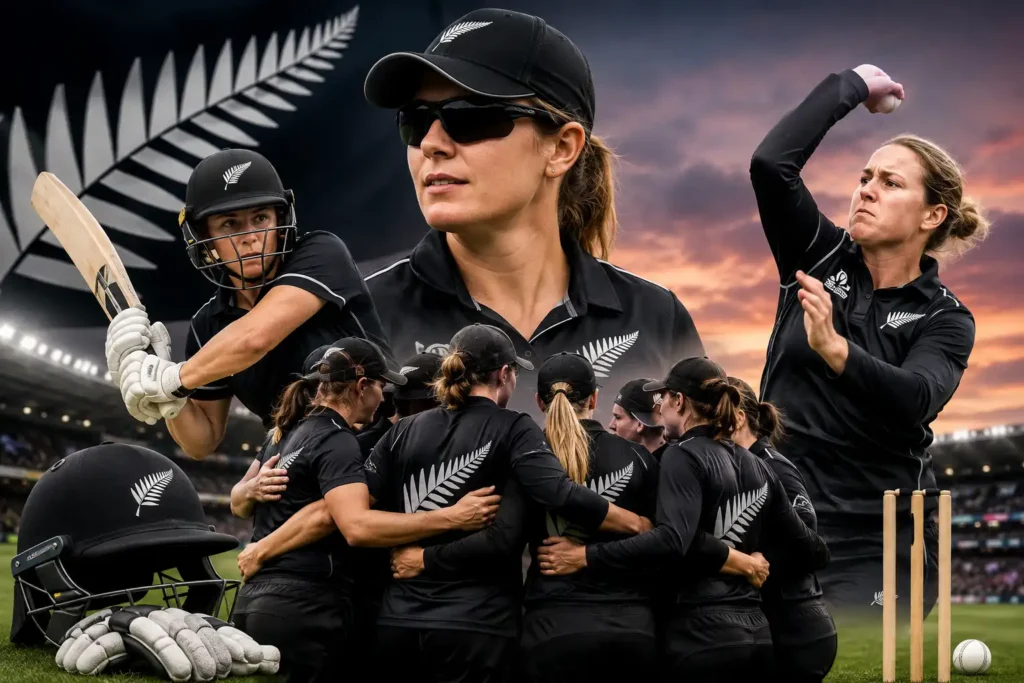
New Zealand Women: Team, Players, Matches, and Cricket Guide New Zealand Women are a respected team in international women’s cricket. I think New Zealand women, known as the White Ferns, have enjoyed success in one-day internationals (ODIs) and twenty-over international cricket (T20Is). I think young players have joined New Zealand Women, giving cricket fans a chance to watch promising talent. I think New Zealand women made history in 2024 when New Zealand women won the ICC Women’s T20 World Cup, defeating South Africa in the final. I think New Zealand Women as title defenders showed teams in the 2026 tournament that New Zealand Women mean business. The New Zealand Women’s squad had a mix of experienced players and new talent. New Zealand Women’s Team and Key Players The White Ferns have players who can change a match with either bat or ball. Amelia Kerr, called Melie Kerr, has become a key all‑rounder in New Zealand women. Amelia Kerr took over the captaincy from Sophie Devine. Amelia Kerr’s skill with both bat and ball gives New Zealand Women a balance. Old‑time players have helped New Zealand women grow. Sophie Devine and Suzie Bates are among New Zealand women’s famous names in women’s cricket. The 2026 T20 World Cup was very important because Sophie Devine, Suzie Bates, and Lea Tahuhu were set to end their careers after that tournament. Other players in the New Zealand women’s squad are Jess Kerr, Rosemary Mair, Maddy Green, Brooke Halliday, Georgia Plimmer, Izzy Gaze, Bree Illing, Nensi Patel, and Izzy Sharp. New Zealand Women show how they mix international players with young players who are starting their careers. Why New Zealand Women Are Important in International Cricket New Zealand women are known for disciplined cricket and strong team play. New Zealand women’s success does not rely on a player. New Zealand women’s batters, all‑rounders, fast bowlers, and spinners can all give help depending on the conditions. The New Zealand Women’s 2024 T20 World Cup win was a moment for the team. New Zealand women entered the 2026 tournament as defending champions, adding expectation. New Zealand women also kept preparing with series before the tournament, playing matches against South Africa and England. New Zealand Women’s Matches and Live Scores Fans who want to watch New Zealand Women matches can check fixtures, results, scorecards, wickets, partnerships, and player performances on cricket score services. I find that a live score is very helpful when a match takes place during working hours or when the full broadcast is not available and New Zealand Women fans rely on score updates from cricket score services to stay in the loop. For each New Zealand Women game, useful details are the playing XI, toss result, innings score, wickets, overs, run rate, and final result. Looking at these details gives fans a view of how the New Zealand Women’s match is developing without watching every ball. New Zealand Women in T20 Cricket T20 cricket is one of the events on the New Zealand Women’s schedule. I think that New Zealand women’s win in the 2024 T20 World Cup proved that New Zealand women can handle pressure well when playing in a tournament. The 2026 campaign was a time for New Zealand women. They faced challenges that year. New Zealand women lost their two matches and then won by four runs over Ireland to keep qualification hopes alive.I watched Melie Kerr play in that match.Saw Melie Kerr use both bat and ball again, showing how vital Melie Kerr’s all‑round skills are to the New Zealand Women’s cricket team. Frequently Asked Questions Who are the New Zealand women in cricket? The New Zealand women’s cricket team is called the White Ferns. The captain of the New Zealand Women’s team is not mentioned in the provided information. Melie Kerr is the captain of New Zealand Women. Melie Kerr took over the captaincy from long‑time captain Sophie Devine. I wonder who the famous New Zealand women cricketers are.I have seen many New Zealand women players display skill on the field, and I feel proud of each New Zealand women player. The New Zealand Women’s team has players such as Amelia Kerr, Sophie Devine, Suzie Bates, Lea Tahuhu, Jess Kerr, and Rosemary Mair. I felt proud watching the New Zealand women play well. Did the New Zealand women win the T20 World Cup? Yes, the New Zealand women won the ICC Women’s T20 World Cup in 2024. In 2026 the New Zealand women were the defending champions.The New Zealand Women played alongside the teams. I am proud of New Zealand women. Where can I follow New Zealand women’s live scores? You can follow New Zealand women’s live scores on cricket score sites that give updates, scorecards, fixtures, and results. What formats do New Zealand women play? New Zealand women play ODI and T20I cricket. New Zealand women also take part in ICC women’s tournaments and bilateral series. Who are the all‑rounders in New Zealand Women? Amelia Kerr and Sophie Devine are all‑rounders for New Zealand women. Amelia Kerr and Sophie Devine help New Zealand women a lot with both bat and ball.
ICC Women’s Players: 9 Exciting Stars Defining the Sport
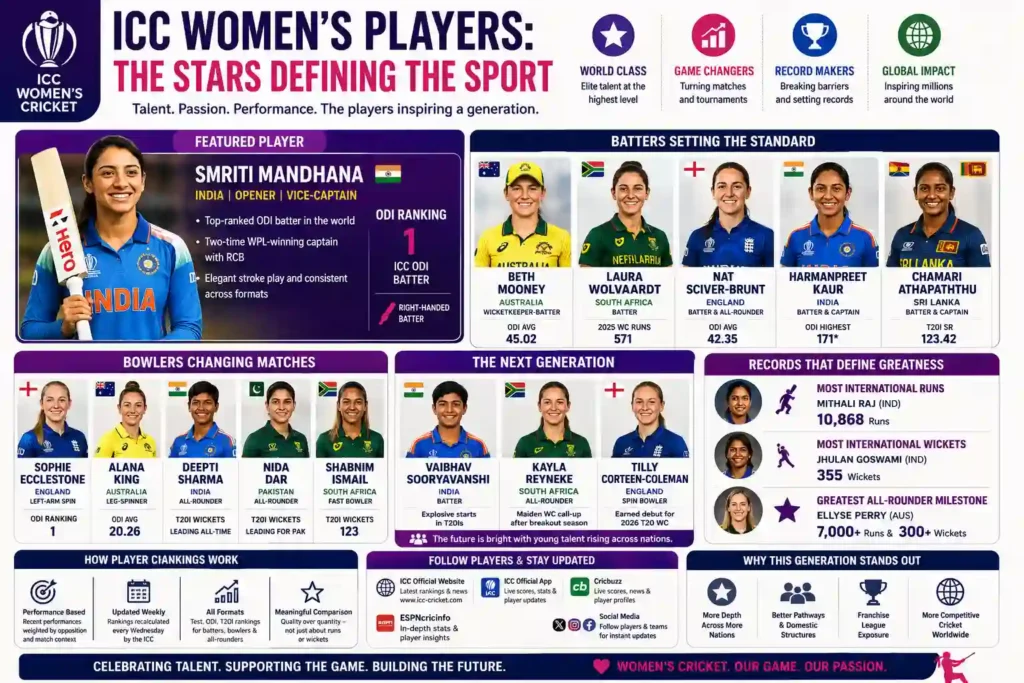
ICC Women’s Players: 9 Exciting Stars Defining the Sport Individual brilliance drives interest in cricket as much as team success does, and the current generation of women’s cricketers includes some of the most complete players the sport has ever produced. Here’s an overview of the players currently shaping the international game, with links to our full profiles as they’re published. Full Player Profiles Smriti Mandhana — India’s vice-captain, currently the top-ranked ODI batter in the world, and a two-time WPL-winning captain with Royal Challengers Bengaluru. Her combination of technical elegance and consistent run-scoring across all three formats has made her one of the most watched players in the sport. We’re adding further in-depth profiles regularly — check back for more as they’re published. The Batters Setting the Standard Beyond Mandhana at the top of the ODI rankings, several other batters have defined the current era. Australia’s Beth Mooney combines wicketkeeping reliability with genuine consistency at the top of the order, while South Africa’s Laura Wolvaardt has been in career-best form across formats, finishing as the leading run-scorer at the 2025 World Cup with 571 runs. England’s Nat Sciver-Brunt brings genuine all-round value as both a top-order batter and reliable medium-pace option, and has captained England through one of the more emotionally significant tournaments in the program’s recent history. India’s Harmanpreet Kaur remains one of the format’s most feared finishers, holding the record for the highest score by an Indian in a Women’s World Cup knockout match with her unbeaten 171 against Australia in 2017 — an innings widely credited with transforming public interest in women’s cricket in India. Her captaincy has also delivered multiple WPL titles with Mumbai Indians, adding to a résumé that already included leading India to a T20 World Cup final in 2020. The Bowlers Changing Matches On the bowling side, England’s Sophie Ecclestone has held the top spot in the ICC’s ODI bowling rankings for an extended stretch, her left-arm spin becoming one of the most difficult things to face in the world game. Australia’s Alana King brings genuine leg-spin unpredictability to the middle overs, while India’s Deepti Sharma became the all-time leading wicket-taker in T20I history during the 2026 T20 World Cup, adding to an already impressive all-round résumé. Pakistan’s Nida Dar holds her own format-specific record as the leading T20I wicket-taker in Pakistan’s history, while veteran South African quick Shabnim Ismail continues to add to her own national record — 123 T20I wickets — even at 37 years old, having returned to the squad for the 2026 T20 World Cup after an absence. The Next Generation Coming Through Beyond the established stars, a genuinely exciting group of younger players is starting to force their way into senior selection across several nations. India’s Vaibhav Sooryavanshi has drawn attention for his explosive starts at the top of the order in bilateral T20I cricket, while South Africa’s Kayla Reyneke earned a maiden World Cup call-up after a breakthrough domestic season, averaging 53 with the bat and picking up wickets regularly in her first senior T20Is. England handed debuts to uncapped talents including spinner Tilly Corteen-Coleman ahead of their home T20 World Cup campaign in 2026, blending fresh faces into a squad built around considerable senior experience. That pipeline of emerging talent matters well beyond the individual players themselves — it’s a genuine indicator of how much deeper domestic structures and age-group pathways have become across multiple nations over the past several years, and it suggests the current generation of stars won’t be followed by any kind of talent drop-off once they eventually retire. The Records That Define Greatness Some of the sport’s most important individual milestones belong to players who’ve already retired but whose numbers still shape how current players are measured. Mithali Raj holds the record for most international runs by any woman, with 10,868 across a two-decade career. Jhulan Goswami retired as the all-time leading wicket-taker in women’s international cricket, with 355 wickets. Ellyse Perry became the first woman to combine 7,000 international runs with 300 wickets, a genuinely unmatched all-round résumé that’s kept her a first-choice Australian selection well into her thirties. We’ve covered these records, and many more, in full detail in our guide to women’s cricket rankings and records — essential reading for understanding exactly where the current generation of stars sits relative to the players who came before them. How Player Rankings Work Individual player rankings are recalculated weekly by the ICC, weighting performances by the quality of opposition faced and the specific match situation, rather than simply totalling runs or wickets. A century against a weak attack scores differently than the same total against a top-ranked bowling lineup in a tight contest. For the current standings across every format and discipline, our rankings page tracks exactly where every top player sits right now. Following Player Form and News Individual form tends to shift quickly — a player can move several places in the rankings after a single strong series, and breakthrough performances from emerging talent happen regularly across bilateral cricket and franchise leagues alike. Our news section covers standout individual performances alongside broader team and tournament coverage, and our team guides — including India Women, Australia Women, England Women, South Africa Women and Pakistan Women — cover each squad’s key players in the context of their national team’s recent results. Why This Generation Stands Out What makes the current crop of players genuinely notable isn’t just individual quality — it’s the sheer depth across nations that historically struggled to produce world-class talent consistently. Players from South Africa, Sri Lanka and the West Indies are now regularly featuring in the same conversations as stars from Australia, England and India, a shift driven directly by increased access to franchise cricket, better domestic structures, and simply more matches played at a genuinely competitive level. That broadening of talent is part of why following individual players has become just as rewarding as following team results — there are more genuine stars playing meaningful
ICC Women’s Teams: 9 Exciting Teams You Need to Know
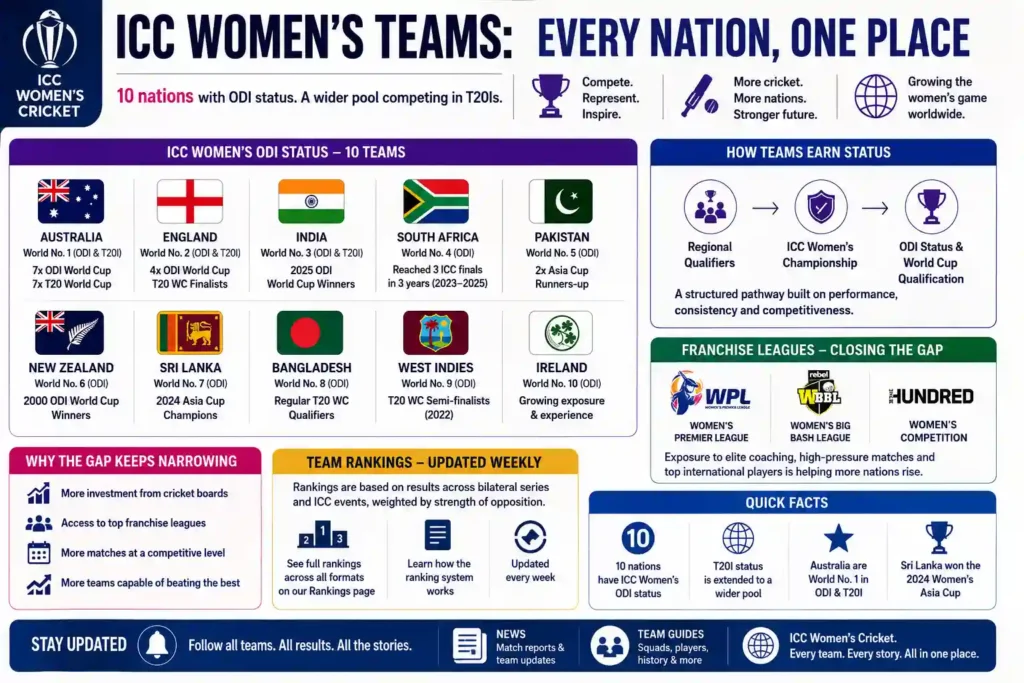
ICC Women’s Teams: 9 Exciting Teams You Need to Know Ten nations currently hold ICC Women’s ODI status, with a wider pool competing in T20I cricket following the format’s expansion across ICC membership. Some of these teams have decades of history and multiple World Cup titles behind them; others are still building toward their first major breakthrough. Here’s a complete overview of where every major team currently stands, with links to our full guides on the nations we’ve covered in depth. How Teams Earn Their Status Full ICC membership and ODI status aren’t automatic — nations work their way up through a structured pathway involving regional qualifying tournaments and the ICC’s Women’s Championship system, which also determines qualification for the biggest events like the World Cup. That structure means the ten current ODI-status nations have all demonstrated a sustained level of competitiveness over time, rather than simply being granted status on potential alone. Associate nations continue to push for recognition through that same pathway, with T20I status now extended much more broadly than ODI status ever has been, giving a considerably wider group of countries international match experience to build from. The Top Tier Australia are the benchmark of the sport — ranked No. 1 in both ODI and T20I cricket, and the most successful team in World Cup history with seven titles in each format. Their combination of squad depth, domestic infrastructure and sustained investment has kept them at or near the top for the better part of two decades. India enter this era as reigning ODI World Cup champions, having won their first-ever global title in 2025. Ranked third in both major formats, India combine genuine star power with one of the deepest domestic pathways in the sport, powered significantly by the Women’s Premier League. England sit second in both ODI and T20I rankings, and remain one of the most consistent teams at global tournaments, even with a frustrating recent history of losing T20 World Cup finals specifically to Australia — most recently on home soil in 2026. South Africa have emerged as one of the form teams in world cricket, reaching three ICC finals in as many years without yet winning one — a near-miss record matched by very few programs in the sport’s history. Captain Laura Wolvaardt’s individual form has been central to that rise, and the program’s broader trajectory suggests the breakthrough title may simply be a matter of time rather than a question of genuine competitiveness. Building Toward the Top Pakistan remain a work in progress at the global level, still searching for a first knockout-stage appearance at an ICC tournament, despite reaching two Women’s Asia Cup finals and producing genuinely talented individual players like captain Fatima Sana. New Zealand carry one of the sport’s more storied histories, including a Women’s ODI World Cup title in 2000 and a run of individual record-breakers like Amelia Kerr, even as the team has found consistent top-four finishes difficult in recent cycles. The White Ferns’ relatively small playing population compared to nations like Australia and England means squad depth has occasionally been a limiting factor, even when individual talent has been world-class. Sri Lanka shocked the region by winning the 2024 Women’s Asia Cup, breaking a long run of India-Pakistan dominance in that tournament, and remain one of the more improved sides in world cricket over the past few years. Captain Chamari Athapaththu has been central to that rise, combining explosive batting at the top of the order with a leadership style that’s helped instil genuine belief in a squad that spent years being treated as a near-certain group-stage exit at global events. Bangladesh continue building a domestic structure to match their growing international ambitions, having qualified consistently for major T20 World Cups even without yet reaching the knockout stages. The board’s investment in age-group and domestic pathways over the past several years is aimed specifically at closing that gap over the coming World Cup cycles. West Indies have historically punched above their ranking at global events, including a run to the T20 World Cup semi-finals in 2022, though missing qualification for the most recent ODI World Cup was a setback for a program that’s produced genuine world-class talent over the years, including all-rounders and power-hitters who’ve become fixtures in franchise leagues around the world even when the national team itself has struggled for consistency. Ireland represent the growing depth of the associate and newer full-member nations, gaining increasing exposure against top-tier opposition as the international calendar continues to expand. The Role of Franchise Leagues in Closing the Gap Player access to the three major domestic franchise leagues — the WPL, the WBBL and The Hundred Women’s Competition — has become one of the clearest factors separating teams that are closing the gap on the top tier from those still lagging behind. Nations whose players regularly feature in these leagues gain direct exposure to elite coaching, high-pressure match situations, and international teammates and opponents week in, week out, in a way bilateral series alone simply can’t replicate. Players from South Africa, New Zealand, Sri Lanka and the West Indies have all benefited visibly from that exposure in recent years, and it’s a big part of why their national teams have become noticeably more competitive against the traditional top tier. By contrast, nations whose top players have less regular access to those leagues — often due to visa complications, scheduling conflicts with domestic commitments, or simply fewer contracts on offer from the host boards — tend to find it harder to close the gap purely through bilateral cricket and ICC events alone. That dynamic is likely to keep shaping which teams rise fastest over the next few World Cup cycles. How These Teams Are Ranked Team rankings are recalculated weekly based on results across bilateral series and ICC events, weighted by the strength of the opposition faced rather than a simple win-loss tally. For the exact current standings across all three formats, our rankings page tracks where
ICC Women’s Live Score: 7 Easy Ways to Follow Matches Live
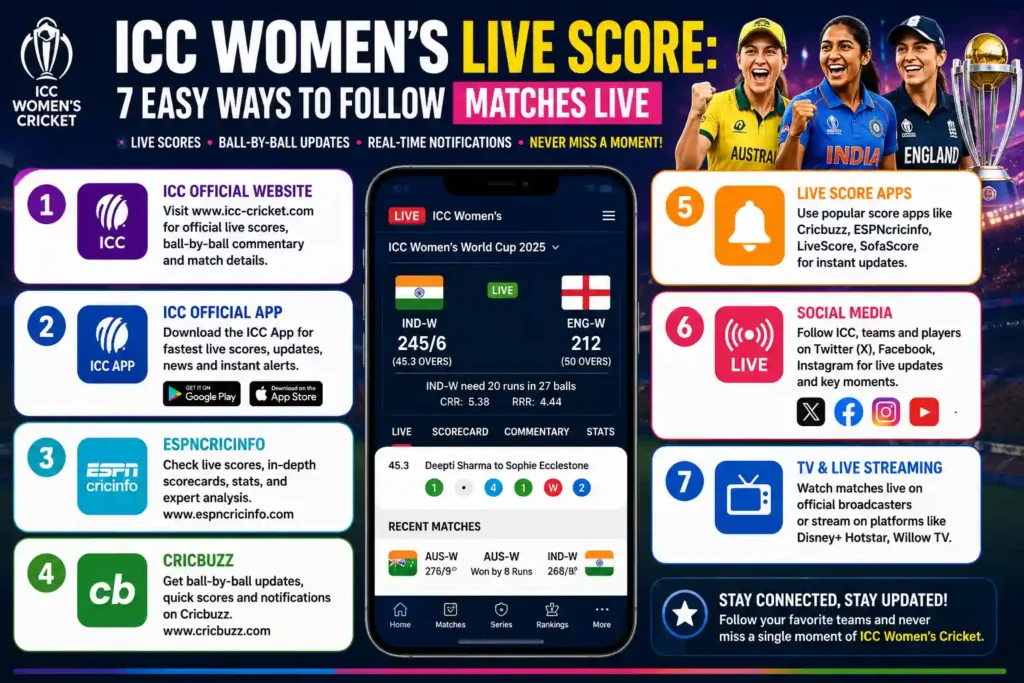
ICC Women’s Live Score: 7 Easy Ways to Follow Matches Live Live scoring is one of the most immediate ways fans engage with cricket, and women’s international matches are covered in genuinely comprehensive detail across a range of sources during play. Here’s what to know about following live scores, and how to make the most of ball-by-ball coverage while a match is underway. What Live Coverage Actually Includes A proper live score feed for a cricket match goes well beyond just the runs and wickets tally. Ball-by-ball commentary tracks every delivery, run rate calculations update in real time, and detailed scorecards break down each batter’s individual contribution and each bowler’s figures as the innings develops. For T20I matches specifically, live win-probability estimates have also become increasingly common on major platforms, giving fans a running sense of how the match is shifting with each over. Where to Find Live Scores Official team and tournament broadcasters typically provide the most reliable live coverage in their respective regions — the broadcaster holding rights to a particular series or tournament will usually offer both video coverage and a companion live text feed. Major cricket statistics platforms also provide detailed ball-by-ball scoring independent of broadcast rights, often with more detailed statistical breakdowns than a simple broadcast graphic can show. National cricket boards’ official apps and websites are another reliable option, particularly for bilateral series that might not get broadcast as widely as major ICC tournaments. Why We Don’t Publish Live Scores Directly This site focuses on match reports, analysis and context — the story behind a result, why it matters, and how it fits into a team’s broader season — rather than duplicating the real-time ball-by-ball feeds that dedicated live-scoring platforms already provide well. Once a match concludes, our news section covers the result in full, and our ICC Women’s Results guide rounds up major outcomes across the sport. Making the Most of Live Cricket If you’re following a match live for the first time, it helps to have some context on the teams involved before the game starts. Our guides to India Women, Australia Women, England Women, South Africa Women and Pakistan Women cover current squads, key players and recent form — genuinely useful background for understanding why a particular passage of play, bowling change or batting collapse matters within the bigger picture of a team’s season. Our ICC Women’s Players guide also covers the individual stars most likely to be central to any given live match. After the Final Ball Once a match wraps up, the story usually isn’t finished — a result often shifts team rankings, affects World Cup qualification standing, or changes the context for the next match in a series. Our rankings page reflects those changes as they’re officially updated, and our team and tournament guides get refreshed as results come in, so the context around any given match stays current well after the live scoring feed has moved on to the next fixture. Frequently Asked Questions Where can I find live scores for ICC Women’s cricket matches? Official broadcasters holding rights to a specific series, along with major cricket statistics platforms and national board apps, typically provide the most detailed live ball-by-ball coverage. Does this site provide live match scoring? No — this site focuses on match reports, analysis and team context rather than duplicating real-time ball-by-ball feeds already provided well by dedicated live-scoring platforms. What does a full live cricket scorecard typically include? Ball-by-ball commentary, updated run rates, individual batting and bowling figures, and in T20I cricket, often live win-probability estimates as the match develops. How quickly do team rankings update after a live match ends? Rankings are recalculated on a weekly basis by the ICC, so a single match result may not be reflected immediately, but it factors into the next scheduled update. Where can I read about a match after it’s finished? Our news section covers match reports and results as they’re confirmed, with full context on how the outcome fits into each team’s broader season.
ICC Women’s Results: 7 Exciting Things You Need to Know
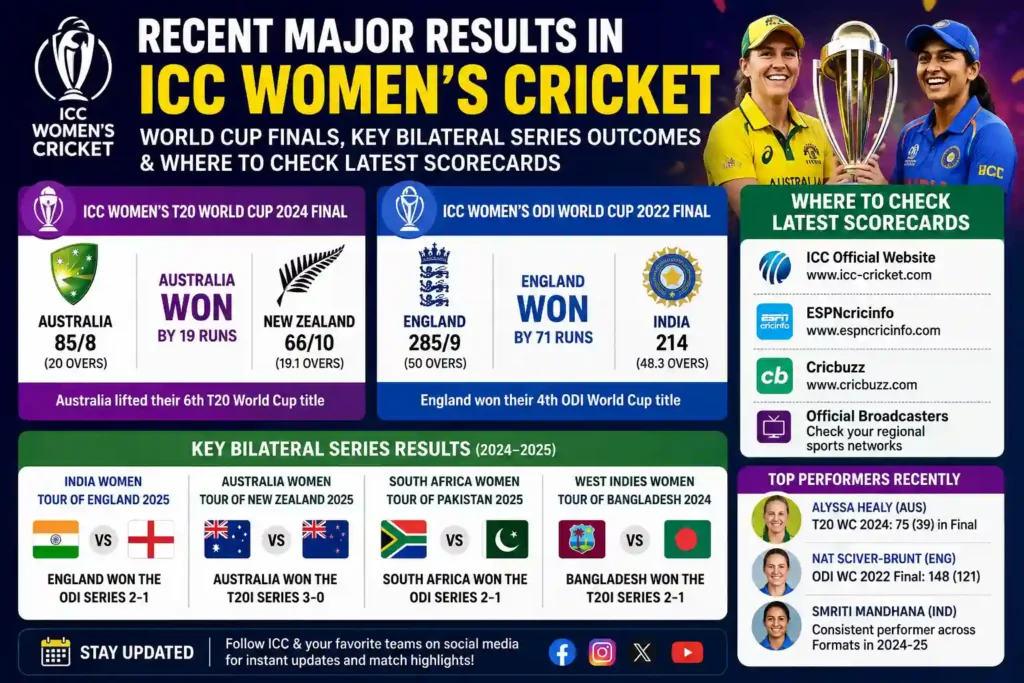
ICC Women’s Results: 7 Exciting Things You Need to Know Keeping up with results across international women’s cricket means following a genuinely busy calendar — bilateral series, ICC tournaments and three major domestic leagues all producing outcomes worth knowing about throughout the year. Here’s a look at the major results shaping the current era of the sport, plus where to check outcomes as new matches are completed. The Results That Have Defined 2025-26 India won their first-ever ICC Women’s Cricket World Cup in November 2025, beating South Africa by 52 runs in the final at Navi Mumbai — a genuinely historic result after two previous runner-up finishes across the tournament’s history. We’ve covered that title win in full in our India Women team guide. Australia won the 2026 T20 World Cup, beating hosts England in the final at Lord’s to claim a seventh title in the format — extending their record as the most successful nation in the sport’s history across both World Cup formats combined. Our Australia Women guide covers that campaign in detail. Sri Lanka won the 2024 Women’s Asia Cup, beating India in the final to end a long run of India-Pakistan dominance in that tournament — one of the more significant upsets in recent regional cricket history. Royal Challengers Bengaluru won the 2026 WPL final, beating Delhi Capitals to claim their second title in four seasons, with captain Smriti Mandhana named Player of the Match. Our WPL guide covers every season’s result in full. Hobart Hurricanes won their first WBBL title in the 2025-26 season, beating Perth Scorchers by eight wickets in the final. Full season-by-season results are covered in our WBBL guide. Why Results Matter Beyond the Scoreline A single result rarely tells the whole story in women’s cricket right now, given how tightly bunched the top of the rankings has become. South Africa, for instance, have lost three ICC finals in as many years but remain one of the form teams in the sport — their results in those specific matches don’t reflect a team in decline, but rather a genuinely elite side that’s fallen agonisingly short at the very last stage each time. Understanding the context behind a result — the opposition faced, the stage of the tournament, the conditions — is usually more useful than the bare scoreline alone. How to Track Results as They Happen For team-specific results and how they fit into a nation’s broader form, our guides to India Women, England Women, South Africa Women and Pakistan Women cover recent series outcomes in context. Our news section covers match reports as results come in across every major series and tournament, and our rankings page shows how the latest results have shifted the official standings. For live scores while a match is actually in progress, our ICC Women’s Live Score guide points you toward the best real-time sources, since results coverage like this page is generally most useful once a match has concluded. Frequently Asked Questions Who won the most recent Women’s Cricket World Cup? India won the 2025 edition, beating South Africa by 52 runs in the final — their first-ever World Cup title. Who won the 2026 T20 World Cup? Australia, beating hosts England in the final at Lord’s to claim their seventh T20 World Cup title. Where can I find live match results as they happen? Official broadcasters and major cricket statistics sites provide live scoring during matches. Our coverage focuses on match reports and analysis once results are confirmed. Why do South Africa keep losing ICC finals despite being a strong team? South Africa have reached three ICC finals in three years — the 2025 ODI World Cup and the 2023 and 2024 T20 World Cups — losing all three by narrow margins, a reflection of genuinely elite form rather than any underlying weakness. Who won the most recent WPL and WBBL titles? Royal Challengers Bengaluru won the 2026 WPL, and Hobart Hurricanes won the 2025-26 WBBL, their first title in the competition’s history.
ICC Women’s Schedule: 5 Things Every Fan Should Know
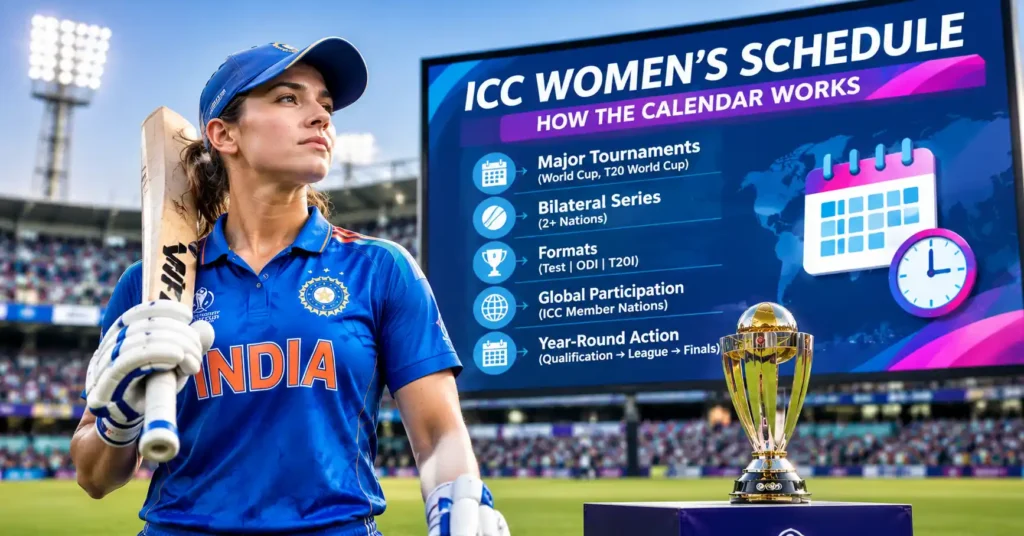
ICC Women’s Schedule: 5 Things Every Fan Should Know The modern women’s cricket calendar is busier than it’s ever been, blending bilateral international tours, major ICC tournaments, and three separate domestic franchise leagues into a single year-round schedule. Here’s how it’s all structured, and where to find the most current fixture information for any team or tournament you’re following. The Building Blocks of the Calendar Bilateral tours make up the bulk of the international calendar between major tournaments. A tour typically involves one nation travelling to another for a mix of Tests, ODIs and T20Is, scheduled through agreements between the two boards involved, often built around the ICC’s Women’s Championship structure for ODI fixtures specifically. ICC events — the World Cup, T20 World Cup, and qualifying tournaments — are scheduled on their own multi-year cycles and take priority over bilateral commitments when they clash, with national boards typically clearing several weeks of the calendar entirely around a major tournament. Domestic franchise leagues have increasingly claimed their own fixed windows on the calendar. The WPL now runs in a dedicated January-to-February slot, the WBBL runs through the Australian summer from November into December, and The Hundred Women’s Competition occupies a dedicated window during the English summer in July and August. We’ve covered each league’s format and schedule pattern in our guides to the Women’s Premier League, the Women’s Big Bash League and The Hundred Women’s Competition. Why the Calendar Has Gotten So Crowded A decade ago, a top international player might have had relatively clear stretches of the year outside bilateral tours and a single major tournament. Now, the same player is likely juggling international duty across three formats, a WPL contract, and potentially a WBBL or Hundred contract too, all within the same twelve months. That’s produced a genuinely packed calendar for the sport’s biggest stars, with boards and league organisers increasingly having to negotiate around each other’s fixed windows to avoid direct clashes. It’s also meant much tighter turnarounds between major commitments than fans might expect — the WBBL, for instance, has begun just days after the conclusion of a Women’s World Cup in recent cycles, leaving players very little recovery time between a global tournament and the start of a demanding domestic season. Finding Team-Specific Schedules Because the calendar varies so much by nation and time of year, the most reliable way to track a specific team’s schedule is directly through that team’s coverage. Our guides to India Women, Australia Women, England Women, South Africa Women and Pakistan Women each cover recent and upcoming fixtures in the context of the team’s broader form and squad news. For official, continuously updated fixture lists, each national board’s official website and the ICC’s own site remain the definitive sources, since a printed or static schedule can shift due to weather, venue changes or broader scheduling conflicts. Staying Current Our news section covers upcoming series announcements and squad news as they’re confirmed, and our ICC Women’s Results guide covers how to track outcomes once matches in any given window have been completed. For live ball-by-ball coverage once a match is actually underway, our ICC Women’s Live Score guide points you toward the best real-time sources. Frequently Asked Questions How is the international women’s cricket calendar structured? Around a mix of bilateral tours, ICC tournaments on their own multi-year cycles, and fixed windows for the three major domestic franchise leagues — the WPL, WBBL and The Hundred Women’s Competition. Why has the women’s cricket calendar become so busy? Increased investment in domestic franchise leagues alongside a growing international bilateral schedule has left top players juggling international duty and multiple league contracts within the same twelve months. When is each major domestic league played? The WPL runs from January to February, the WBBL runs through the Australian summer from November into December, and The Hundred Women’s Competition runs during the English summer in July and August. Where can I find the most up-to-date fixture list for a specific team? National cricket boards’ official websites and the ICC’s own site provide the most current fixture information, since schedules can shift due to weather or other scheduling changes. Do ICC tournaments take priority over bilateral series? Yes — national boards typically clear their calendars around major ICC events, with bilateral commitments scheduled around those fixed tournament windows rather than the other way around.
ICC Women’s Matches: 7 Best Ways to Follow Them
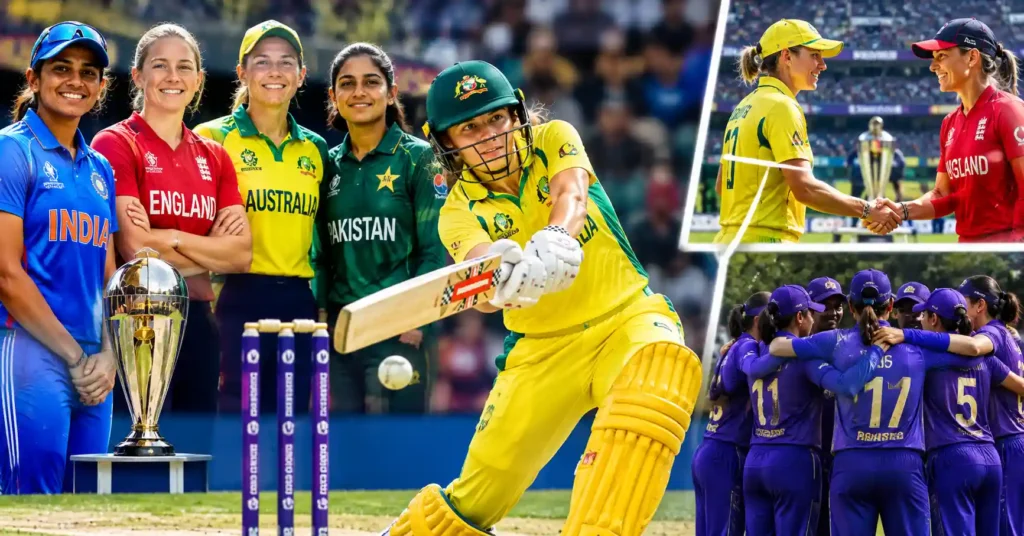
ICC Women’s Matches: 7 Best Ways to Follow Them Every match in international women’s cricket falls into one of three formats, each with its own rhythm, strategy and significance. Understanding the differences — and knowing which fixtures carry extra weight beyond the scoreline — makes following the sport considerably more rewarding. Here’s everything you need to know about how ICC Women’s matches actually work. The Three Formats Test matches are the longest and rarest format in women’s cricket, played over up to four or five days depending on the series. Because so few Tests get scheduled compared to white-ball cricket, each one tends to carry outsized significance — a Test win is a genuinely uncommon achievement for most nations, and standout individual performances in the format are remembered for years given how infrequently the opportunity arises. One Day Internationals (ODIs) are played over 50 overs per side and form the backbone of the ICC Women’s Championship qualification structure, which determines who reaches the World Cup. Most bilateral tours include an ODI leg, and ODI form is generally considered one of the clearest indicators of a team’s overall strength given how much more regularly it’s played than Test cricket. Twenty20 Internationals (T20Is) are the shortest and most widely played format, with 20 overs per side and the fastest pace of scoring. T20I status has been extended to a much broader pool of ICC member nations than ODI status, making it the format where genuinely new cricketing nations are most likely to get international match experience. Bilateral Series vs Tournament Cricket Matches happen in two broad contexts. Bilateral series see one nation touring another for a set number of matches in a single format or a mix of formats — anywhere from a standalone three-match T20I series to a full multi-format tour including a Test, ODIs and T20Is. Tournament cricket, by contrast, groups multiple nations together in a single event with its own group stage and knockout structure, culminating in ICC global events like the World Cup or regional competitions like the Women’s Asia Cup. Some bilateral series carry extra structural weight — the Women’s Ashes between Australia and England, for instance, combines a Test, three ODIs and three T20Is into a single combined points race rather than three separate results, giving every match in the series direct bearing on the overall outcome. Rivalries Worth Following Closely A handful of fixtures consistently draw more attention than a typical bilateral match, regardless of the tournament context. India versus Pakistan carries significance well beyond cricket itself, drawing some of the largest broadcast audiences in the sport whenever the two nations meet. Australia versus England, through both the Women’s Ashes and regular ICC tournament meetings, remains one of the sport’s most storied rivalries — England have reached four T20 World Cup finals and lost all of them specifically to Australia. India versus Australia has also become a genuinely must-watch fixture in recent years, as both nations’ rise toward the top of the rankings has made their meetings increasingly competitive. Where Matches Are Played Match venues vary considerably depending on the series and host nation, ranging from major international stadiums with tens of thousands of capacity to smaller regional grounds used for less high-profile bilateral fixtures. Major ICC events tend to concentrate matches across a handful of marquee venues in the host country — the 2025 World Cup, for instance, was co-hosted across venues in India and Sri Lanka, while the 2026 T20 World Cup used grounds throughout England including Lord’s for the final. Following Matches as They Happen For fixture-by-fixture schedules, our ICC Women’s Schedule guide covers how the international calendar is structured. Once matches are underway, our ICC Women’s Live Score guide points you toward the best sources for ball-by-ball coverage, and our ICC Women’s Results guide covers how to keep track of outcomes across every major series and tournament. For deeper context on the teams involved in any given match, our guides to India Women, Australia Women, England Women, South Africa Women and Pakistan Women cover each nation’s current squad and recent form, and our news section covers match reports and standout performances as they happen. Frequently Asked Questions What are the three formats of international women’s cricket? Test matches, One Day Internationals (ODIs, 50 overs per side) and Twenty20 Internationals (T20Is, 20 overs per side). Why is Test cricket so rare in the women’s game? Test matches require significantly more scheduling commitment than white-ball cricket, and many boards prioritise ODI and T20I fixtures given their broader appeal and lower cost. Some nations have played only a handful of Tests in their entire history. What’s the difference between a bilateral series and a tournament? A bilateral series involves two nations playing each other directly over a set number of matches, while a tournament groups multiple nations together in a group-stage and knockout format, such as a World Cup. Which women’s cricket rivalry draws the most attention? India versus Pakistan consistently draws some of the largest broadcast audiences in the sport, regardless of the tournament context or either team’s current form. How does the Women’s Ashes differ from a normal bilateral series? It combines a Test, three ODIs and three T20Is into a single combined points race rather than three separate series results, giving every match direct bearing on the overall outcome.
ICC Women’s Cricket: Best Guide to 9 Teams & More
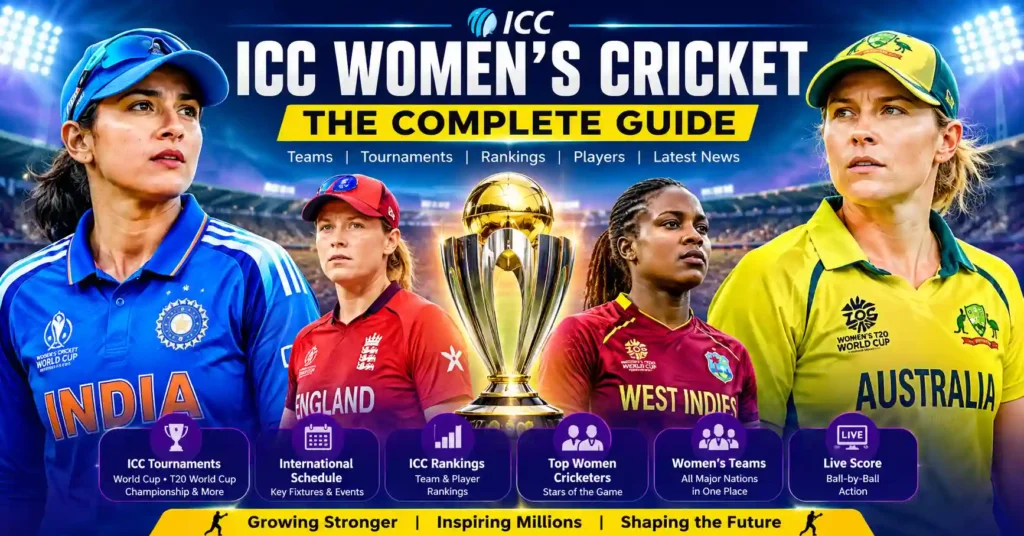
ICC Women’s Cricket: The Complete Guide Women’s cricket has changed faster than almost any other sport over the last decade — bigger crowds, bigger broadcast deals, and a genuinely competitive field of nations capable of winning any major tournament on their day. Whether you’re new to the sport or you’ve followed it for years and just want one place to make sense of everything, this guide covers exactly what you need: what ICC Women’s Cricket actually is, the tournaments that matter, how the rankings work, who the teams and players are, and where to follow it all as it happens, from the newest fan to the most dedicated follower of the international game. Explore ICC Women’s Cricket What Is ICC Women’s Cricket? ICC Women’s Cricket refers to international cricket played by women’s national teams under the governance of the International Cricket Council, the sport’s global governing body. It covers all three formats of the game — Test cricket, One Day Internationals (ODIs) and Twenty20 Internationals (T20Is) — played between the national teams of ICC member nations, from long-established cricketing powers like Australia and England through to newer full members and associate nations still building their international programs. The ICC oversees the major global events in the women’s game, sets playing regulations, and maintains the official player and team rankings that track form across all three formats. Alongside international cricket, a growing number of domestic franchise leagues — the Women’s Premier League in India, the Women’s Big Bash League in Australia, and The Hundred Women’s Competition in England — now sit alongside the international calendar as major fixtures in their own right, drawing many of the same international stars into club competition for several weeks each year. Why Test Cricket Remains Rare Of the three formats, Test cricket remains by far the least common in the women’s game. Where ODIs and T20Is are scheduled regularly across bilateral tours and major tournaments, Women’s Tests are still relatively infrequent — some nations, like Pakistan, have played only a handful across their entire international history, while others, including Australia and England, schedule them more consistently as part of ongoing rivalries like the Women’s Ashes. That scarcity means a Test win or a standout individual Test performance tends to carry outsized significance in the women’s game, precisely because the opportunities to achieve one come around so rarely compared to white-ball cricket. There’s been a gradual push from several boards to schedule more Test cricket in recent years, driven partly by player advocacy and partly by a recognition that the format offers a different kind of showcase for the game’s technical depth. Whether that translates into a genuinely busier Test calendar in the coming years remains one of the more interesting structural questions facing the sport. Major Competitions in Women’s Cricket Several tournaments define the international calendar each cycle: The ICC Women’s Cricket World Cup — the 50-over format’s biggest prize, held roughly every four years. India won the most recent edition in 2025, their first-ever title, beating South Africa in the final. Australia remain the tournament’s most successful side by a wide margin, with seven titles overall. The ICC Women’s T20 World Cup — the sport’s flagship short-format event, also held on a roughly biennial cycle in recent years. Australia won the 2026 edition, beating hosts England in the final at Lord’s, extending their own record to seven T20 World Cup titles as well. The Women’s Championship — an ICC-run league structure that determines qualification pathways for the ODI World Cup, giving context and stakes to bilateral ODI series between top-ranked nations outside of the World Cup itself. The Women’s Asia Cup — a regional tournament contested primarily between South Asian nations, with India historically the dominant side, though Sri Lanka’s 2024 title win broke a long run of finals dominated by India and Pakistan. The Commonwealth Games — women’s T20 cricket has featured at the Commonwealth Games in recent editions, adding another multi-sport stage to the international calendar. The Women’s U19 World Cup — a newer addition to the global calendar, giving the sport’s next generation of stars a genuine global tournament of their own before stepping up to senior international cricket. Beyond ICC events specifically, the three major domestic leagues have become genuine fixtures of the wider cricket calendar. We’ve covered each in detail: the Women’s Premier League, The Hundred Women’s Competition, and the Women’s Big Bash League each have their own format, history and list of champions worth knowing. Matches, Schedule and Results The international women’s calendar runs year-round, blending bilateral series between individual nations with the major ICC events described above. Bilateral tours — a team travelling to play a Test, ODI or T20I series against a single opponent — make up the bulk of the calendar between World Cups, while franchise league windows are increasingly blocked out on the calendar too, meaning a genuinely busy year for the sport’s top players across international and domestic commitments alike. For the latest fixtures, results and schedules, our news section covers match reports and squad announcements from every major team as they happen. Keeping track of a specific team’s schedule is often the easiest way to follow the sport day to day, since it’s rare for every major nation to be playing at once outside of a global tournament window. Understanding the Rankings ICC rankings track form across Test, ODI and T20I cricket for both teams and individual players, updated weekly using a points system that weighs performance quality rather than simple win-loss records. We’ve broken down exactly how that system works, along with the sport’s biggest individual records, in our complete guide to women’s cricket rankings and records — essential reading if you want to understand why a team or player’s position can shift even without playing a match that week. For the current standings themselves, our rankings page tracks where every ranked nation and player currently sits across all three formats. The Teams Ten nations currently hold ICC Women’s ODI
South Africa Women Cricket: 3 Essential Finals, Best Guide
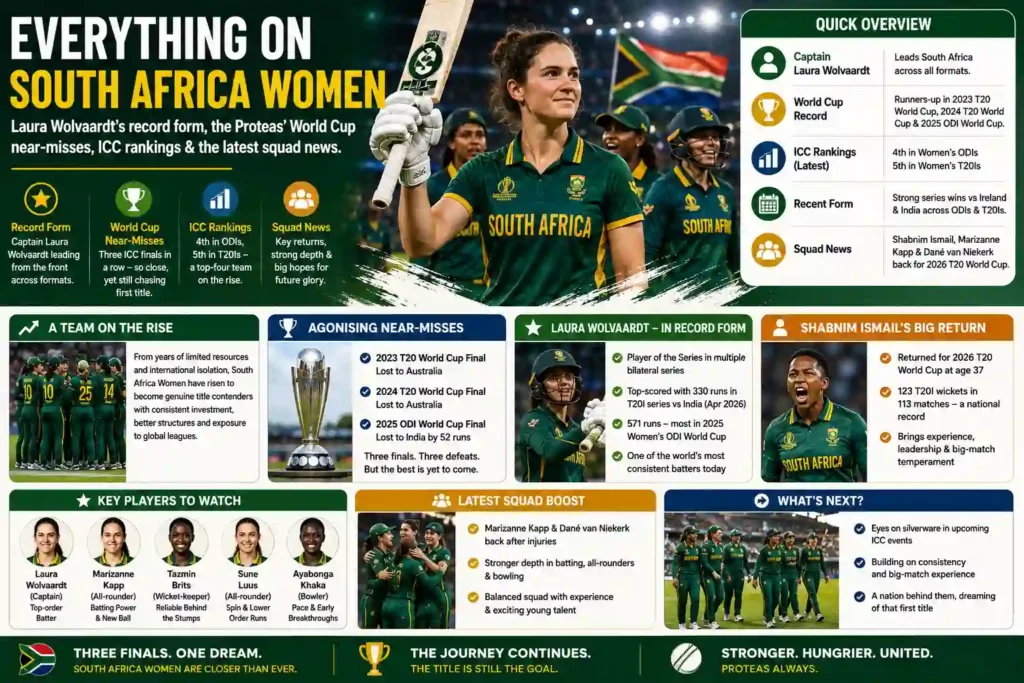
South Africa Women Cricket Team: Squad, Rankings, Records & Latest News No team in women’s cricket has come closer to a global title without actually winning one than South Africa. The Proteas have reached three ICC finals across the last two World Cup cycles and lost every single one, even as captain Laura Wolvaardt has established herself as arguably the most in-form batter anywhere in the world. Here’s the complete picture of where South Africa stand right now, from the squad and leadership through to the near-misses that have defined this era of the program. Leadership and Current Setup Laura Wolvaardt captains South Africa across formats, and her leadership has coincided with the most successful stretch of results in the program’s history — even if the biggest trophies have so far stayed just out of reach. Mandla Mashimbyi serves as head coach, having taken over the role in late 2024, with a support staff that includes Dillon du Preez as bowling coach and Andrew Puttick as batting coach. A Program on a Genuine Upward Trajectory It’s worth putting South Africa’s recent finals appearances in the context of where the program stood not so long ago. South Africa’s women’s team spent years operating well outside the sport’s top tier, hampered historically by limited resources compared to boards like Australia, England and India, and by the broader sporting boycott South Africa faced during the apartheid era, which meant the team didn’t play international fixtures for an extended stretch of its early history. Rebuilding from that isolation, and from decades of comparatively limited investment afterward, makes the program’s rise to three consecutive ICC finals all the more significant. That upward trajectory has been driven by increased investment from Cricket South Africa in the women’s program over the past several years, including more consistent contracts, better domestic structures, and greater exposure for South African players to overseas franchise leagues like the WPL and WBBL. Players returning from those competitions with sharpened skills and experience against the world’s best have become a genuine feeder into the improved national team performances seen over this recent stretch. Where South Africa Sit in the Rankings South Africa currently sit fourth in the ICC Women’s ODI rankings and fifth in the Women’s T20I rankings — positions that arguably understate just how competitive this team has been at major tournaments recently, given how close they’ve come to winning multiple global titles in the last few years. For the latest standings across all three formats, our rankings page tracks exactly where South Africa and every other nation currently sit, and our guide to how the ranking system works breaks down the mechanics behind those weekly updates. A Program Defined by Agonising Near-Misses South Africa’s recent history at ICC events follows an almost identical, painful pattern. At the 2025 Women’s Cricket World Cup, the Proteas reached their first-ever ODI World Cup final, only to lose to hosts India by 52 runs at Navi Mumbai — the closest South Africa have ever come to a global 50-over title. We’ve covered that tournament, and India’s historic maiden win, in detail in our guide to the India Women’s national team. The T20 World Cup has followed an even more repetitive script. South Africa reached back-to-back finals in 2023 and 2024, losing both times to Australia — the same opponent that’s denied England a title on four separate occasions, as we’ve covered in our England Women team guide. That gives South Africa three ICC final appearances in as many years across both formats, with three defeats to show for it — a run of consistency reaching the biggest stage that very few programs in the sport’s history can match, made all the more frustrating by how narrowly each of those finals was lost. Laura Wolvaardt’s Remarkable Form Whatever the team’s results in ICC finals, there’s little argument about the individual quality driving South Africa’s rise. Wolvaardt has been named Player of the Series in an extraordinary run of consecutive bilateral series — including South Africa’s 3-0 ODI and 2-0 T20I sweep of Ireland in December 2025, and their 4-1 T20I series win over India in April 2026, where she top-scored with 330 runs across the five matches. She was also the leading run-scorer at the 2025 World Cup itself, finishing with 571 runs — comfortably the highest tally of any batter in the tournament, even in a losing final. That combination of sustained individual dominance and team success just short of the ultimate prize has made Wolvaardt one of the most closely followed captains in the sport, and arguably the single biggest reason South Africa have gone from the periphery of world cricket’s contender conversation to a genuine top-four side within just a few years. The Shabnim Ismail Story One of the more compelling individual storylines in South Africa’s recent squad has been the return of veteran fast bowler Shabnim Ismail for the 2026 T20 World Cup. At 37, Ismail came back into the international fold for the first time since South Africa’s defeat to Australia in the 2023 final, bringing with her a national record of 123 wickets in 113 T20I matches — the most by any South African in the format’s history. Her recall added a wealth of experience to a squad that had reached the final of the previous two editions of the tournament, giving Wolvaardt a proven big-match performer to call on in the biggest moments. Alongside Ismail, the squad also welcomed back all-rounders Marizanne Kapp and Dané van Niekerk after injury setbacks, further deepening a group already showing genuine strength in depth heading into the tournament — a level of squad depth that would have been unimaginable for South Africa’s women’s program a decade or two ago. Key Players to Know Beyond Wolvaardt’s batting and Ismail’s experience, South Africa’s squad carries real depth across departments. Marizanne Kapp remains one of the most complete all-rounders in world cricket, equally capable of contributing with bat and ball in the toughest moments of