ICC Women’s Teams: 9 Exciting Teams You Need to Know
Ten nations currently hold ICC Women’s ODI status, with a wider pool competing in T20I cricket following the format’s expansion across ICC membership. Some of these teams have decades of history and multiple World Cup titles behind them; others are still building toward their first major breakthrough. Here’s a complete overview of where every major team currently stands, with links to our full guides on the nations we’ve covered in depth.
How Teams Earn Their Status
Full ICC membership and ODI status aren’t automatic — nations work their way up through a structured pathway involving regional qualifying tournaments and the ICC’s Women’s Championship system, which also determines qualification for the biggest events like the World Cup. That structure means the ten current ODI-status nations have all demonstrated a sustained level of competitiveness over time, rather than simply being granted status on potential alone. Associate nations continue to push for recognition through that same pathway, with T20I status now extended much more broadly than ODI status ever has been, giving a considerably wider group of countries international match experience to build from.
The Top Tier
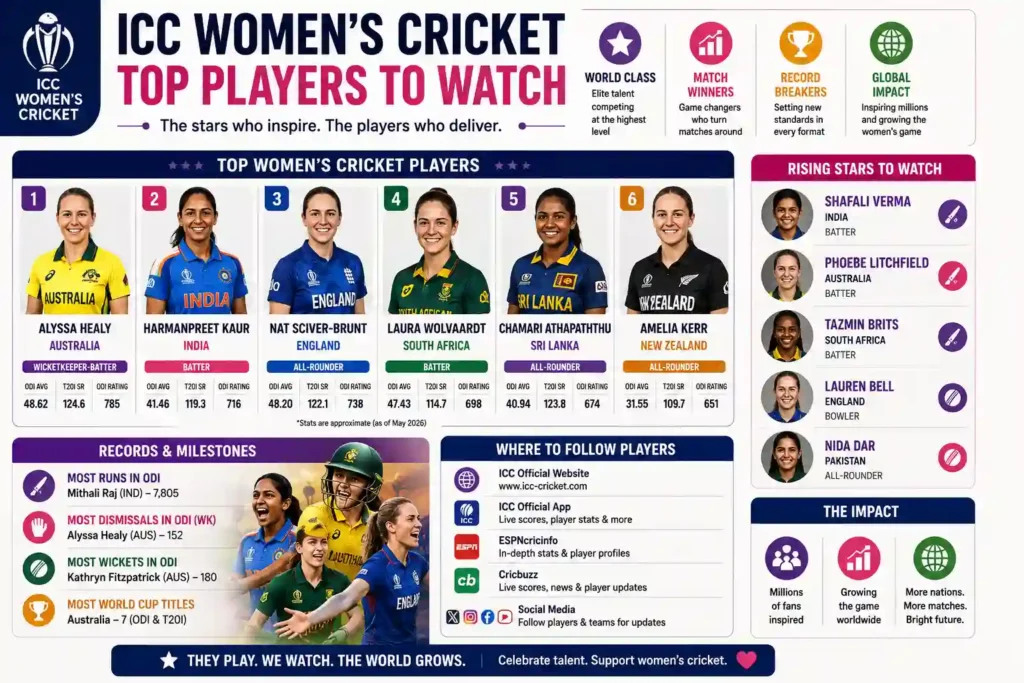
Australia are the benchmark of the sport — ranked No. 1 in both ODI and T20I cricket, and the most successful team in World Cup history with seven titles in each format. Their combination of squad depth, domestic infrastructure and sustained investment has kept them at or near the top for the better part of two decades.
India enter this era as reigning ODI World Cup champions, having won their first-ever global title in 2025. Ranked third in both major formats, India combine genuine star power with one of the deepest domestic pathways in the sport, powered significantly by the Women’s Premier League.
England sit second in both ODI and T20I rankings, and remain one of the most consistent teams at global tournaments, even with a frustrating recent history of losing T20 World Cup finals specifically to Australia — most recently on home soil in 2026.
South Africa have emerged as one of the form teams in world cricket, reaching three ICC finals in as many years without yet winning one — a near-miss record matched by very few programs in the sport’s history. Captain Laura Wolvaardt’s individual form has been central to that rise, and the program’s broader trajectory suggests the breakthrough title may simply be a matter of time rather than a question of genuine competitiveness.
Building Toward the Top
Pakistan remain a work in progress at the global level, still searching for a first knockout-stage appearance at an ICC tournament, despite reaching two Women’s Asia Cup finals and producing genuinely talented individual players like captain Fatima Sana.
New Zealand carry one of the sport’s more storied histories, including a Women’s ODI World Cup title in 2000 and a run of individual record-breakers like Amelia Kerr, even as the team has found consistent top-four finishes difficult in recent cycles. The White Ferns’ relatively small playing population compared to nations like Australia and England means squad depth has occasionally been a limiting factor, even when individual talent has been world-class.
Sri Lanka shocked the region by winning the 2024 Women’s Asia Cup, breaking a long run of India-Pakistan dominance in that tournament, and remain one of the more improved sides in world cricket over the past few years. Captain Chamari Athapaththu has been central to that rise, combining explosive batting at the top of the order with a leadership style that’s helped instil genuine belief in a squad that spent years being treated as a near-certain group-stage exit at global events.
Bangladesh continue building a domestic structure to match their growing international ambitions, having qualified consistently for major T20 World Cups even without yet reaching the knockout stages. The board’s investment in age-group and domestic pathways over the past several years is aimed specifically at closing that gap over the coming World Cup cycles.
West Indies have historically punched above their ranking at global events, including a run to the T20 World Cup semi-finals in 2022, though missing qualification for the most recent ODI World Cup was a setback for a program that’s produced genuine world-class talent over the years, including all-rounders and power-hitters who’ve become fixtures in franchise leagues around the world even when the national team itself has struggled for consistency.
Ireland represent the growing depth of the associate and newer full-member nations, gaining increasing exposure against top-tier opposition as the international calendar continues to expand.
The Role of Franchise Leagues in Closing the Gap
Player access to the three major domestic franchise leagues — the WPL, the WBBL and The Hundred Women’s Competition — has become one of the clearest factors separating teams that are closing the gap on the top tier from those still lagging behind.
Nations whose players regularly feature in these leagues gain direct exposure to elite coaching, high-pressure match situations, and international teammates and opponents week in, week out, in a way bilateral series alone simply can’t replicate. Players from South Africa, New Zealand, Sri Lanka and the West Indies have all benefited visibly from that exposure in recent years, and it’s a big part of why their national teams have become noticeably more competitive against the traditional top tier.
By contrast, nations whose top players have less regular access to those leagues — often due to visa complications, scheduling conflicts with domestic commitments, or simply fewer contracts on offer from the host boards — tend to find it harder to close the gap purely through bilateral cricket and ICC events alone. That dynamic is likely to keep shaping which teams rise fastest over the next few World Cup cycles.
How These Teams Are Ranked
Team rankings are recalculated weekly based on results across bilateral series and ICC events, weighted by the strength of the opposition faced rather than a simple win-loss tally. For the exact current standings across all three formats, our rankings page tracks where every team currently sits, and our guide to how the ranking system works breaks down the mechanics in full detail.
Why the Gap Between Teams Keeps Narrowing
One of the more encouraging trends in the international women’s game is how much the gap between the top tier and the rest of the field has closed over the past several years. A decade ago, it was fairly rare for more than two or three teams to be considered genuine title contenders heading into a major tournament.
Now, on current form, a reasonable case can be made for at least five or six different sides depending on conditions and squad availability — a shift driven largely by increased investment from more cricket boards, greater access to franchise league experience for players outside the traditional powerhouses, and simply more matches being played at a competitive level across a wider pool of nations.
That narrowing gap is exactly why team-by-team form is worth following closely rather than assuming the same two or three nations will contest every final. Our news section covers results and squad news across every major team as they happen, and our individual team guides go deeper into each nation’s current squad, leadership and recent history.
Frequently Asked Questions
How many teams have ICC Women’s ODI status? Ten nations currently hold full ODI status, with a wider pool of teams competing in T20I cricket following that format’s broader expansion.
Which team is currently ranked No. 1 in women’s cricket? Australia top both the ICC Women’s ODI and Women’s T20I team rankings.
Which teams have won the Women’s Cricket World Cup? Australia (seven times), England (four times), New Zealand (once, in 2000) and India (once, in 2025) are the only nations to have won the tournament.
Which team has reached the most recent ICC finals without winning? South Africa have reached three ICC finals across the last three years — the 2025 ODI World Cup and the 2023 and 2024 T20 World Cups — without winning any of them.
Who won the most recent Women’s Asia Cup? Sri Lanka won the 2024 edition, beating India in the final and ending a long run of India-Pakistan dominance in the tournament.
How does a nation earn ICC Women’s ODI status? Through a structured qualification pathway involving regional tournaments and the ICC’s Women’s Championship system, which also determines qualification for the World Cup itself. ODI status isn’t automatic and reflects a sustained level of competitiveness over time.
Do all ICC member nations play T20I cricket? Yes — T20I status has been extended much more broadly across ICC membership than ODI status, giving a considerably wider pool of nations regular international match experience in the shortest format.