Women’s Ashes Explained: 7 Essential Rules, Best Guide
Ask a casual cricket fan what the Ashes is and they’ll tell you about Australia and England fighting over a tiny urn every couple of years. Ask them about the Women’s Ashes and you’ll usually get a blank look, which is a shame, because it’s arguably a more interesting contest than the men’s version — mostly because of one quirky decision the boards made back in 2013 that changed how the whole series works.
Instead of just playing a Test match, or a T20 series, or an ODI series and calling it a day, the Women’s Ashes combines all three formats into one single points race. Whoever ends up with the most points at the end wins the urn. It sounds simple written down like that, but the details of how those points are handed out are what make this series genuinely different from anything else in international cricket.
Where the Women’s Ashes Actually Came From
Australia and England have been playing each other in women’s cricket since the 1930s, long before most people were paying attention. But the Women’s Ashes as a formal, named contest with an actual trophy only started in 1998, when the Women’s Cricket Association handed over a specially made urn — much smaller and less battered-looking than the men’s one, but symbolically just as loaded.
For years it stayed a fairly low-key affair, usually decided by a single Test match the way the men’s Ashes traditionally was. Then in 2013, both boards agreed to something that hadn’t really been tried before at this level: turn the entire multi-format tour into one combined points table. A team could lose the Test and still win the Ashes overall if they dominated the white-ball games, or vice versa. It changed the psychology of the whole series overnight.
Current Women’s Ashes Format
As things stand, the Women’s Ashes is played as one Test match, three ODIs, and three T20Is — the same multi-format structure that’s been in place since it was introduced. The series alternates hosting duties between Australia and England, and the order in which the formats are played has varied from tour to tour; some series have opened with the white-ball matches and finished with the Test, while others have gone the other way.
The one detail that does move around between editions is the length of the Test itself. It’s been played as both a four-day and a five-day match in different series, depending on what the host board and both teams agree to going in. Everything else — the points on offer, the number of matches, the overall multi-format structure — has stayed consistent since the system was introduced.
How the Points Actually Work
This is the part that trips people up the first time they hear it, so it’s worth breaking down properly.
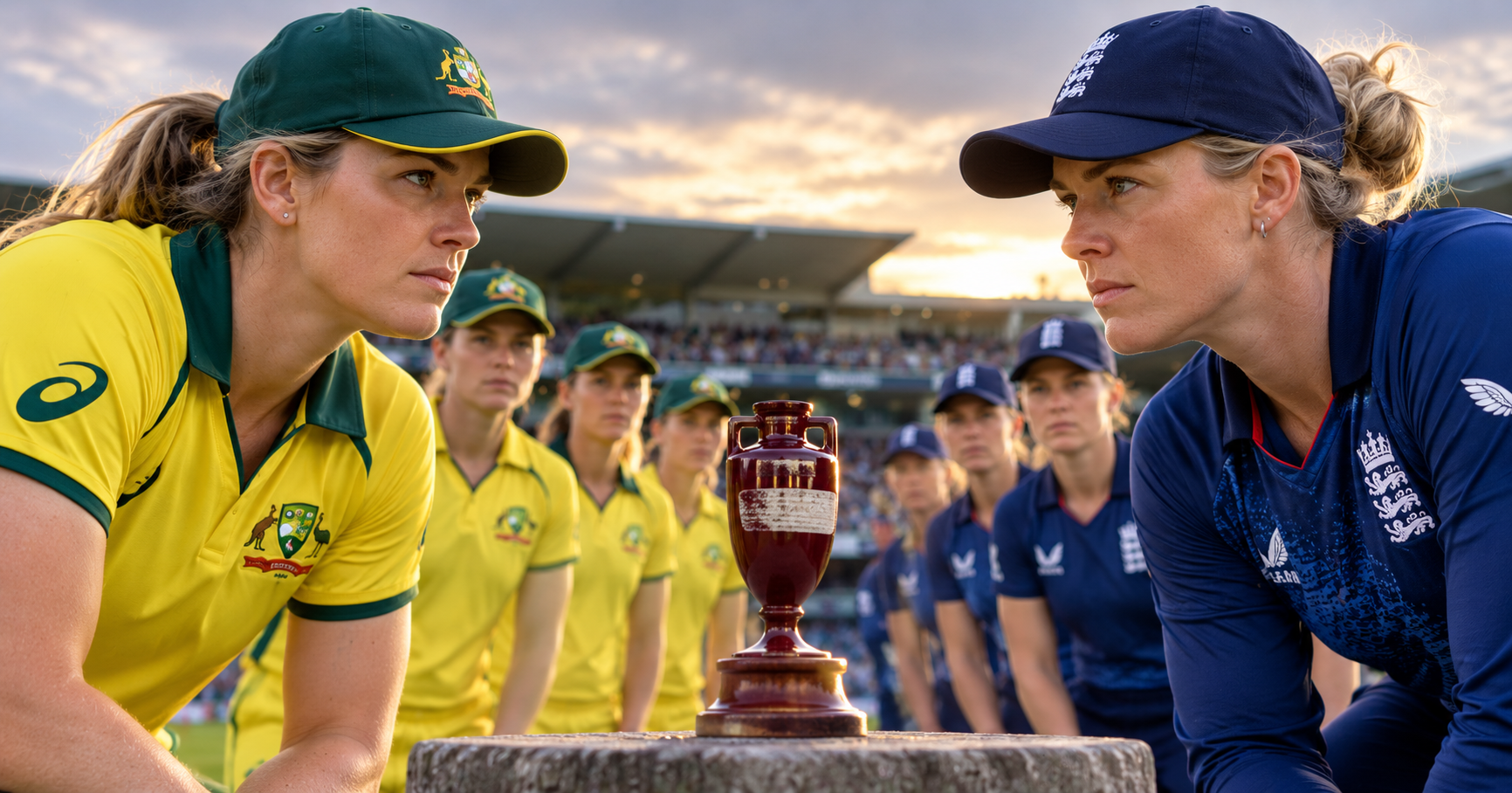
The points aren’t split evenly. A Test match, being the longest and most physically demanding format, carries the heaviest weight — worth double what a single white-ball win is worth. Here’s how it actually breaks down:
| Format | Matches Played | Win | Draw / Tie | No Result |
|---|---|---|---|---|
| Test | 1 | 4 points | 2 points each | — |
| ODI | 3 | 2 points | 1 point each | 1 point each |
| T20I | 3 | 2 points | 1 point each | 1 point each |
So a single Test win is worth as much as two full ODI or T20I victories combined. That single detail changes everything about how captains approach the red-ball leg of the tour. A team that knows it’s weaker in the shorter formats will often go all-in on winning the Test outright, because those four points can basically decide the whole series before a single T20I is even bowled. For the latest schedule and start times of any ongoing multi-format series, the full fixture list is worth checking alongside the points breakdown above.
It also means a drawn Test isn’t a wasted result the way a draw sometimes feels in a standalone Test series. Both sides walk away with two points regardless of how the draw came about — there’s no separate bonus for a first-innings lead the way some other multi-format points systems use. That flat split still shapes how teams approach the final day, though: a side well behind on the white-ball points knows a draw at least keeps them level with the Test points on the table, so batting out the day for safety is often the smarter option than chasing a risky declaration.
Why This Format Actually Works Better Than It Sounds
The obvious criticism when this system was introduced was that it would confuse casual fans, and to be fair, it did for a while. But it solved a real problem. Women’s Test cricket has historically been played far less often than the men’s game — sometimes only one Test a year, if that — which meant a standalone Test series wasn’t really viable as the sole decider. Folding it into a bigger points race gave the Test match actual context and stakes, rather than being a one-off exhibition sandwiched between the white-ball games that fans and broadcasters actually cared more about.
It’s also produced some genuinely dramatic finishes. There have been Ashes series where the entire result came down to the very last T20I, with both sides knowing exactly how many points were on the table and adjusting their tactics accordingly — declaring aggressively in a T20 chase, or bowling defensively to protect a lead, purely because of where the points sat.
The Rivalry Behind the Numbers
Format aside, what makes this series compelling is that Australia and England genuinely don’t like losing to each other. Both boards have invested heavily in their women’s programs over the last decade, and both have produced deep enough squads that neither side can afford to treat the other as an easy fixture.
Australia have generally had the upper hand in terms of overall trophies and consistency — their depth across batting, spin and pace has been the envy of most other boards for years, and it’s no coincidence that Australia currently top the rankings in all three formats. England, though, have had their moments of turning a series on its head with a single dominant performance, often from a bowler finding a spell of form at exactly the right time.
What’s changed more recently is the gap to everyone else. India, South Africa and New Zealand have all closed in on both Australia and England, which puts a slightly different kind of pressure on the Ashes now — neither side can afford a bad series and still assume they’ll bounce back to world number one by default. The margins at the top of the women’s game are tighter than they’ve ever been.
What to Actually Watch For During a Series
If you’re following an Ashes series for the first time, here’s what actually matters beyond just the final scoreline of each match:
The Test result matters more than it looks. Because of the weighting, a team can lose two ODIs and still be ahead overall if they won the Test convincingly. Keep half an eye on the overall points table, not just who won the most recent game.
Momentum genuinely carries across formats. Because all the matches happen within a few weeks of each other, form built up in the Test often carries straight into the white-ball leg. A batter who found rhythm across five days doesn’t just switch that off for the T20Is.
Dead rubbers still matter more than they look. Even once the Ashes is mathematically settled, the remaining matches still add to the overall points margin, and pride alone tends to keep both sides genuinely competitive — a side already holding an unassailable lead will often still push for a clean sweep rather than easing off once the urn is secure.
The multi-format concept — combining a Test, three ODIs and three T20Is into one points race — has been the foundation of the Women’s Ashes since 2013, but the finer details around playing conditions, scheduling, or the points system itself aren’t necessarily locked in forever. Boards do revisit these things between editions, so it’s worth checking the latest official information from the ICC, Cricket Australia and the England and Wales Cricket Board (ECB) before each series rather than assuming an older recap still holds.
Cricket Australia and the ECB publish the confirmed fixtures and playing conditions ahead of every series they host, while the ICC’s official rankings and events pages carry the wider regulations that govern bilateral multi-format series generally. Ball-by-ball coverage, scorecards, player statistics, and match reports can also be cross-checked on ESPNcricinfo after each Women’s Ashes match.
What Happens if the Series Ends in a Tie?
Given how the points are split across three different formats, a level scoreline on points is entirely possible, and it has happened before — the 2023 series in England finished 8-8. In that situation, the holders retain the urn, the same convention used in the men’s Ashes when a series is drawn. Australia went into that 2023 series as holders and kept the urn afterward purely because the points finished level rather than in England’s favour.
It’s a small detail, but it matters for how teams approach a series where they’re already holding the Ashes. A side defending the urn doesn’t necessarily need to win outright — a tie on points is enough to keep hold of it — which occasionally shows up in how conservatively a leading team plays out a dead rubber.

A Format Other Rivalries Could Learn From
There’s a decent argument that other bilateral rivalries in the women’s game should borrow this multi-format points idea rather than just playing three separate, disconnected series. India versus Australia, for instance, already has enough needle between the two sides that turning it into a proper multi-format points race — the way boards have discussed for a “Women’s Trans-Tasman”-style Australia-New Zealand contest — could raise the stakes on every individual match rather than treating each format as its own isolated event.
For now, though, the Ashes remains the one series in women’s cricket where the format itself is almost as big a talking point as the players competing in it. Most fans will tell you they watch for the players — Ecclestone’s spin, Mandhana’s timing, whoever’s in form that particular month — but the reason every single match in the tour actually matters, right down to a T20I with the series technically already decided, comes down entirely to that slightly odd points system a couple of cricket boards agreed on back in 2013.
It’s rare that an administrative decision ends up making a sport more exciting rather than less. This is one of the cases where it did.
For match reports and analysis on the players currently shaping these series, see our latest news and match reports.
FAQ
What is the Women’s Ashes? It’s the multi-format Test, ODI and T20I series played between Australia and England, contested for an urn first awarded in 1998. It’s been decided on a combined points system, rather than a single format, since 2013.
How does the Women’s Ashes points system work? A Test win is worth 4 points, with 2 points each for a draw. An ODI or T20I win is worth 2 points, with 1 point each for a tie or no result. Whichever side has the most points once all seven matches are done wins the series.
How many matches are played in a Women’s Ashes series? Seven in total — one Test, three ODIs, and three T20Is.
Why is the Test match worth more points than a white-ball win? Because it’s the longest and most demanding format, and because there’s only one Test in the whole series. Weighting it at double the points of a white-ball win keeps it meaningful within a schedule that’s otherwise dominated by white-ball cricket.
What happens if the series ends level on points? If the Women’s Ashes finishes level on points, the team holding the Ashes retains the urn. For example, the 2023 Women’s Ashes finished level on points, allowing Australia to retain the urn as the defending holders.