ICC Women’s Players: 9 Exciting Stars Defining the Sport
Individual brilliance drives interest in cricket as much as team success does, and the current generation of women’s cricketers includes some of the most complete players the sport has ever produced. Here’s an overview of the players currently shaping the international game, with links to our full profiles as they’re published.
Full Player Profiles
Smriti Mandhana — India’s vice-captain, currently the top-ranked ODI batter in the world, and a two-time WPL-winning captain with Royal Challengers Bengaluru. Her combination of technical elegance and consistent run-scoring across all three formats has made her one of the most watched players in the sport. We’re adding further in-depth profiles regularly — check back for more as they’re published.
The Batters Setting the Standard
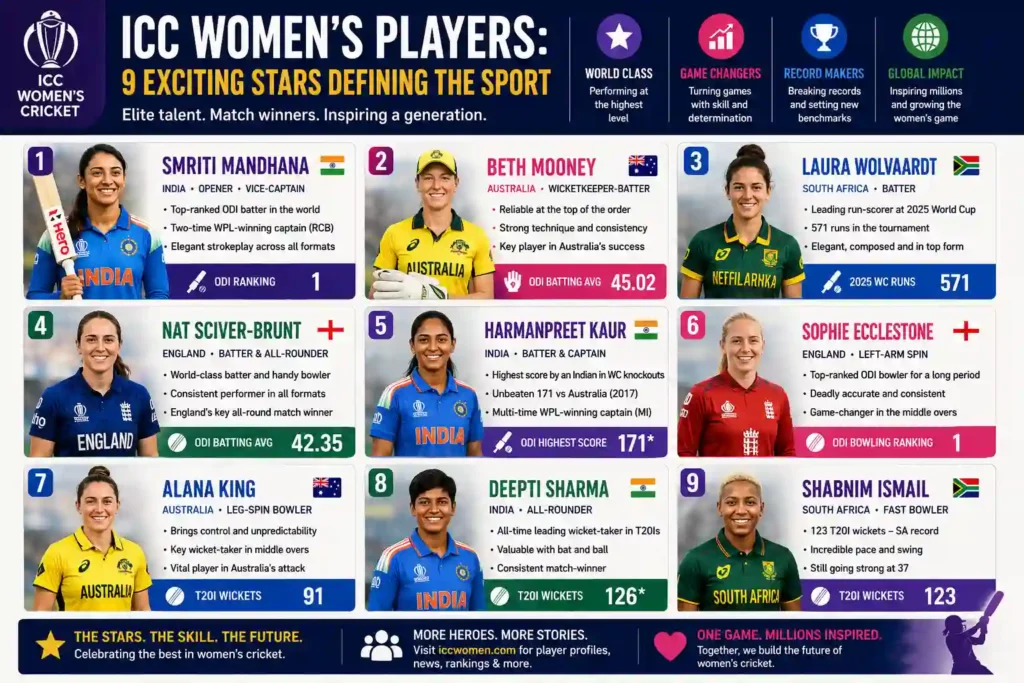
Beyond Mandhana at the top of the ODI rankings, several other batters have defined the current era. Australia’s Beth Mooney combines wicketkeeping reliability with genuine consistency at the top of the order, while South Africa’s Laura Wolvaardt has been in career-best form across formats, finishing as the leading run-scorer at the 2025 World Cup with 571 runs. England’s Nat Sciver-Brunt brings genuine all-round value as both a top-order batter and reliable medium-pace option, and has captained England through one of the more emotionally significant tournaments in the program’s recent history.
India’s Harmanpreet Kaur remains one of the format’s most feared finishers, holding the record for the highest score by an Indian in a Women’s World Cup knockout match with her unbeaten 171 against Australia in 2017 — an innings widely credited with transforming public interest in women’s cricket in India. Her captaincy has also delivered multiple WPL titles with Mumbai Indians, adding to a résumé that already included leading India to a T20 World Cup final in 2020.
The Bowlers Changing Matches
On the bowling side, England’s Sophie Ecclestone has held the top spot in the ICC’s ODI bowling rankings for an extended stretch, her left-arm spin becoming one of the most difficult things to face in the world game. Australia’s Alana King brings genuine leg-spin unpredictability to the middle overs, while India’s Deepti Sharma became the all-time leading wicket-taker in T20I history during the 2026 T20 World Cup, adding to an already impressive all-round résumé.
Pakistan’s Nida Dar holds her own format-specific record as the leading T20I wicket-taker in Pakistan’s history, while veteran South African quick Shabnim Ismail continues to add to her own national record — 123 T20I wickets — even at 37 years old, having returned to the squad for the 2026 T20 World Cup after an absence.
The Next Generation Coming Through
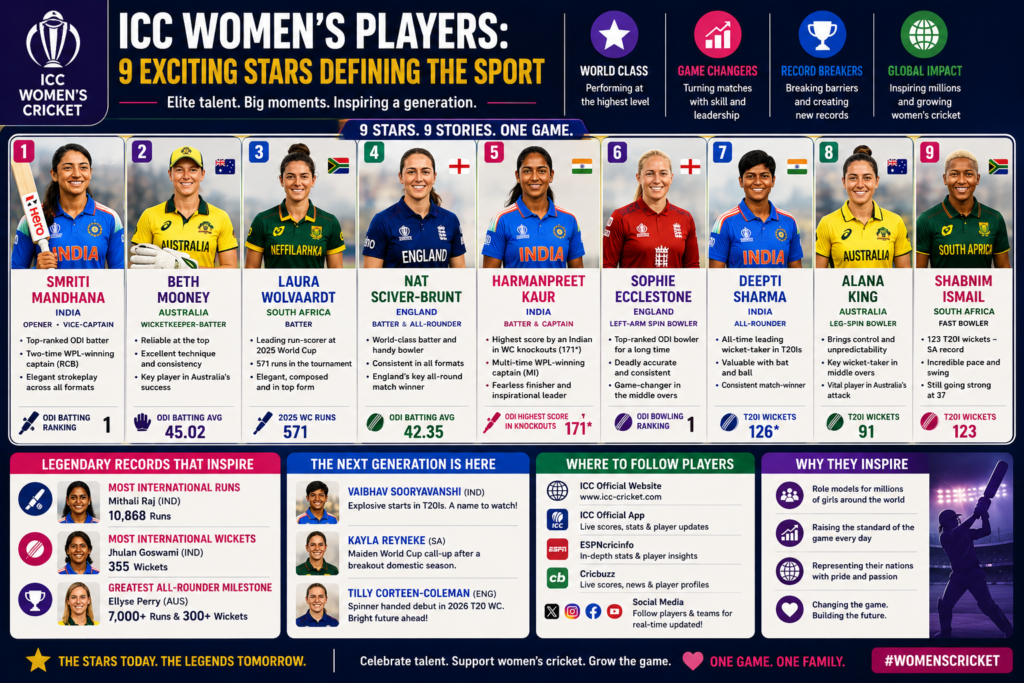
Beyond the established stars, a genuinely exciting group of younger players is starting to force their way into senior selection across several nations. India’s Vaibhav Sooryavanshi has drawn attention for his explosive starts at the top of the order in bilateral T20I cricket, while South Africa’s Kayla Reyneke earned a maiden World Cup call-up after a breakthrough domestic season, averaging 53 with the bat and picking up wickets regularly in her first senior T20Is. England handed debuts to uncapped talents including spinner Tilly Corteen-Coleman ahead of their home T20 World Cup campaign in 2026, blending fresh faces into a squad built around considerable senior experience.
That pipeline of emerging talent matters well beyond the individual players themselves — it’s a genuine indicator of how much deeper domestic structures and age-group pathways have become across multiple nations over the past several years, and it suggests the current generation of stars won’t be followed by any kind of talent drop-off once they eventually retire.
The Records That Define Greatness
Some of the sport’s most important individual milestones belong to players who’ve already retired but whose numbers still shape how current players are measured. Mithali Raj holds the record for most international runs by any woman, with 10,868 across a two-decade career. Jhulan Goswami retired as the all-time leading wicket-taker in women’s international cricket, with 355 wickets. Ellyse Perry became the first woman to combine 7,000 international runs with 300 wickets, a genuinely unmatched all-round résumé that’s kept her a first-choice Australian selection well into her thirties.
We’ve covered these records, and many more, in full detail in our guide to women’s cricket rankings and records — essential reading for understanding exactly where the current generation of stars sits relative to the players who came before them.
How Player Rankings Work
Individual player rankings are recalculated weekly by the ICC, weighting performances by the quality of opposition faced and the specific match situation, rather than simply totalling runs or wickets. A century against a weak attack scores differently than the same total against a top-ranked bowling lineup in a tight contest. For the current standings across every format and discipline, our rankings page tracks exactly where every top player sits right now.
Following Player Form and News
Individual form tends to shift quickly — a player can move several places in the rankings after a single strong series, and breakthrough performances from emerging talent happen regularly across bilateral cricket and franchise leagues alike. Our news section covers standout individual performances alongside broader team and tournament coverage, and our team guides — including India Women, Australia Women, England Women, South Africa Women and Pakistan Women — cover each squad’s key players in the context of their national team’s recent results.
Why This Generation Stands Out
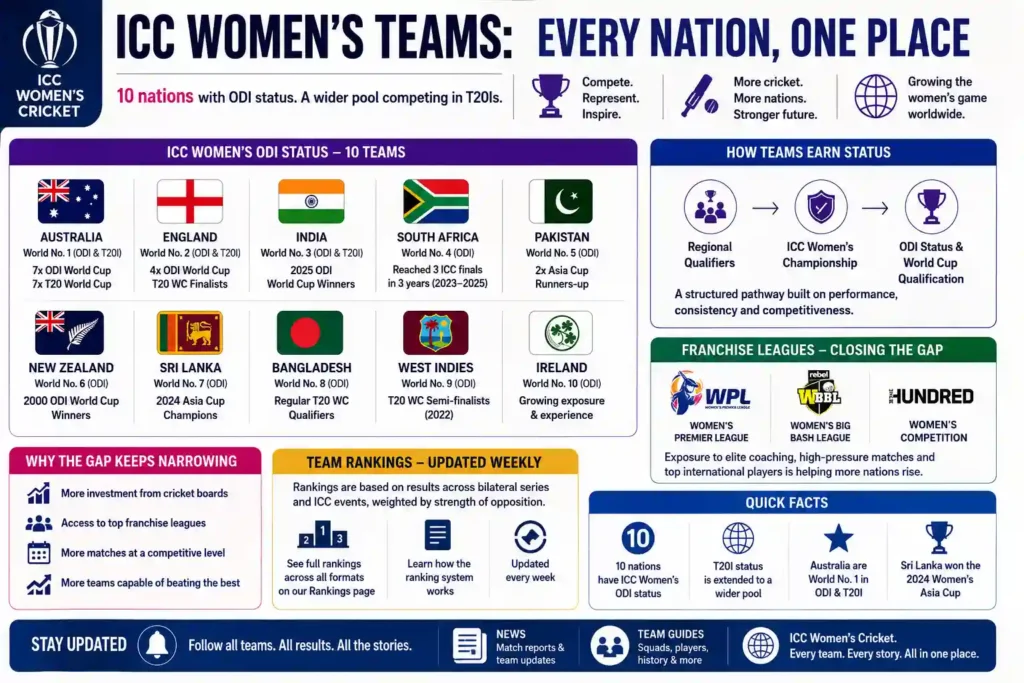
What makes the current crop of players genuinely notable isn’t just individual quality — it’s the sheer depth across nations that historically struggled to produce world-class talent consistently. Players from South Africa, Sri Lanka and the West Indies are now regularly featuring in the same conversations as stars from Australia, England and India, a shift driven directly by increased access to franchise cricket, better domestic structures, and simply more matches played at a genuinely competitive level. That broadening of talent is part of why following individual players has become just as rewarding as following team results — there are more genuine stars playing meaningful cricket right now than at any previous point in the sport’s history.
Frequently Asked Questions
Who is currently the top-ranked ODI batter in women’s cricket? Smriti Mandhana of India currently sits at the top of the ICC Women’s ODI batting rankings.
Who holds the record for most international runs in women’s cricket? Mithali Raj of India, with 10,868 runs across all three formats combined over her two-decade career.
Who is the all-time leading wicket-taker in women’s T20I cricket? India’s Deepti Sharma, who became the format’s leading wicket-taker during the 2026 T20 World Cup.
How often do individual player rankings update? Weekly, based on recent performances weighted by the quality of opposition faced and match context, rather than simple cumulative totals.
Who is considered the greatest all-rounder in women’s cricket history? Australia’s Ellyse Perry is widely regarded as one of the greatest, having become the first woman to combine 7,000 international runs with 300 wickets.