Women’s Cricket Rankings & Records: The Complete Guide
Two questions come up constantly among women’s cricket fans: who’s actually the best right now, and who’s the best of all time. The first one is what the ICC rankings are built to answer, updated every week based on recent form. The second is a much longer story, stretching back to the 1930s and still being rewritten by players who are on the field today. Here’s a full breakdown of both — how the rankings system works, who’s currently near the top of it, and the records that define the sport’s history.
How ICC Women’s Rankings Actually Work
The ICC rankings system for women’s cricket was devised by statistician David Kendix and covers both team and player rankings across all three formats — Tests, ODIs and T20Is. It’s updated weekly, with new figures typically released every Tuesday, so the numbers you see on a Wednesday can look slightly different from what you’d have seen the previous Monday.
The system works on a ratings-points basis rather than a simple win-loss table. For player rankings, batting performance is scored using a combination of runs scored, the quality of the bowling attack faced, and how that innings compares to others in the same match — a century against a weak attack in a one-sided game scores differently than the same total against a strong bowling lineup in a tight contest.
Bowling rankings work in a similar way, weighting wickets by the quality of batter dismissed, runs conceded, and the match situation. New players have a damping factor applied early in their careers, which is why a player can put together a couple of outstanding performances without immediately rocketing to the top of the list — the system wants a body of form, not just a hot streak. It’s a deliberately conservative approach, designed to reward sustained excellence over a single standout series, which is part of why the names near the top of these lists tend to stay fairly consistent from one month to the next rather than reshuffling completely after every tournament.
Team rankings work differently, dividing total points earned across matches and series by the number of matches or series played, similar in concept to a batting average. Currently 10 teams are ranked in the WODI system, while WT20I rankings include every eligible ICC member nation, following the decision to grant full T20I status to matches involving all ICC members — a change that dramatically widened the pool of teams officially tracked in the shortest format compared to just a few years ago.
Who’s Near the Top Right Now
Rankings shift week to week, so treat any specific position as a snapshot rather than a permanent state — but the general shape of the top of the game has been fairly consistent recently. In WODI batting, India’s Smriti Mandhana has been the standout performer, pushing well clear of the chasing pack on the back of a run of strong tournament form, including a century against New Zealand and other significant contributions through a home World Cup campaign. Australia’s Ashleigh Gardner has typically sat close behind her.
Among WODI bowlers, England’s Sophie Ecclestone has been the dominant figure for an extended stretch, with Australia’s leg-spinner Alana King establishing herself as one of the closest challengers to that top spot, generally just ahead of teammate Ashleigh Gardner in the bowling list.
For the exact, up-to-the-week rankings, the official ICC women’s rankings page is the definitive source, broken down separately for WODI and WT20I batting, bowling and all-rounder categories. ESPNcricinfo’s rankings section is another reliable way to cross-check the same figures alongside historical ranking data.
Team Rankings: Who’s Actually at the Top
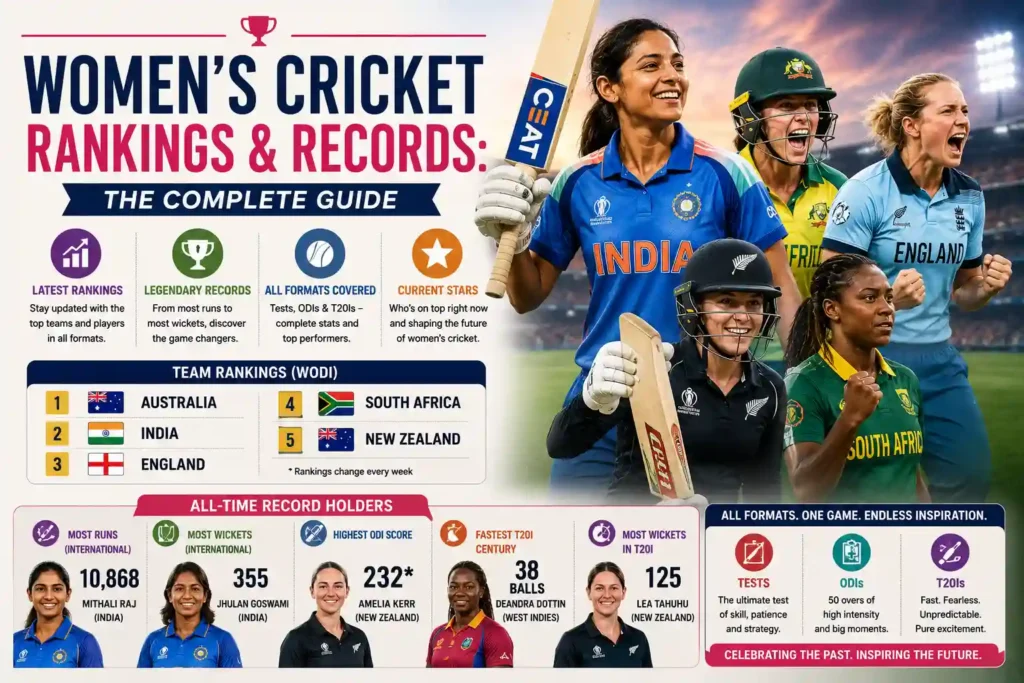
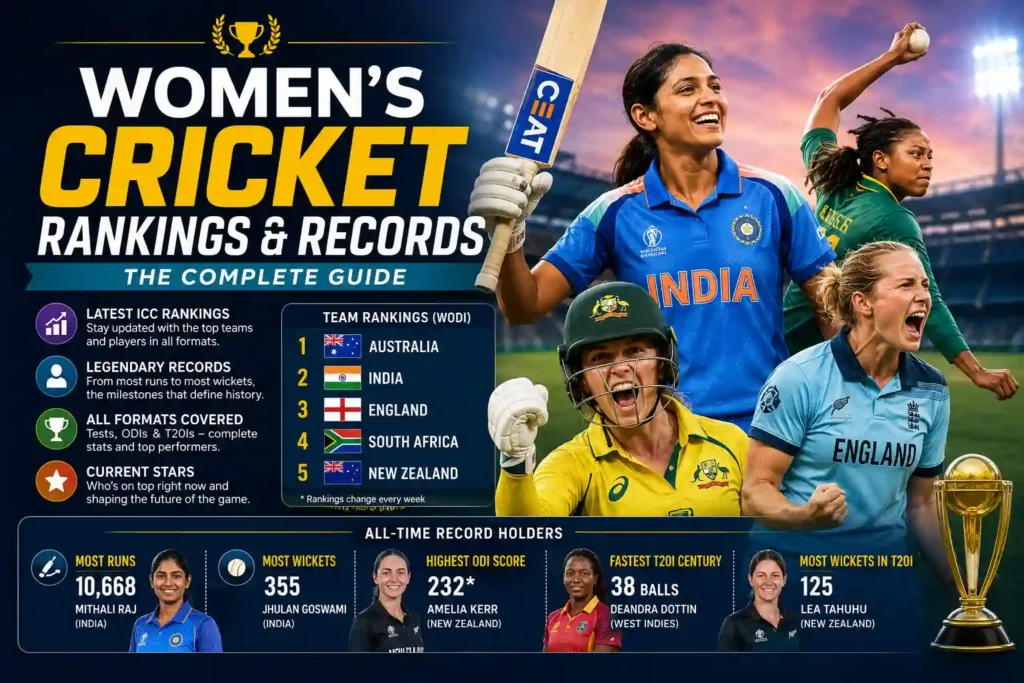
Player rankings tend to get the most attention, but team rankings matter just as much for understanding where the sport currently stands. Australia have generally sat at or near the top of both the WODI and WT20I team rankings for most of the last decade, a reflection of the kind of squad depth that lets them absorb injuries or retirements without dropping off significantly. India, England and South Africa have all closed that gap considerably in recent years, and it’s genuinely common now for the gap between the top three or four teams to be thin enough that a single bilateral series result can shuffle the order.
That tightening at the top is one of the more encouraging signs for the sport overall. A decade ago, it was fairly rare for more than two or three teams to be considered genuine title contenders at a World Cup. Now, on current form, arguments can reasonably be made for at least four or five different sides heading into most major tournaments, which makes the team rankings table considerably more interesting to follow than it used to be.
All-Rounder Rankings Tell a Different Story
Batting and bowling rankings get most of the attention, but the all-rounder category is worth watching separately, since it captures a different kind of value entirely. Players who rank highly here — the Ellyse Perrys, Ashleigh Gardners and Marizanne Kapps of the world — tend to be the ones captains build entire team balances around, since a genuine all-rounder effectively gives a side an extra specialist without using up an additional squad spot. A team with two or three players capable of ranking inside the all-rounder top ten has a selection flexibility that a side built purely around specialists simply doesn’t have, which is part of why national selectors increasingly prioritise developing that kind of player through domestic pathways.
Most Runs in Women’s Cricket
Across all three formats combined, India’s Mithali Raj holds the record for most international runs by any woman, finishing her two-decade career with 10,868 runs between 1999 and 2022. She’s one of only three players to have passed 10,000 international runs, alongside New Zealand’s Suzie Bates and England’s Charlotte Edwards.
Broken down by format, Raj also holds the record for most ODI runs specifically, with 7,805 runs at an average of 50.68 — including a record 71 scores of fifty or more in the format. In T20Is, Suzie Bates leads all scorers with 4,758 runs, a tally built up over one of the longest and most consistent international careers the format has seen.
Most Wickets in Women’s Cricket
India’s Jhulan Goswami holds the overall record for most international wickets, finishing her career with 355 wickets — a mark that sits a considerable distance clear of the next name on the list. She was also the first bowler in the women’s game to reach 250 ODI wickets, eventually finishing with 255 in that format alone, and famously bowled the final over of her international career at Lord’s in 2022, in front of a full house honouring her retirement.
In the T20I format specifically, Pakistan’s Nida Dar became the format’s leading wicket-taker in 2024, overtaking Australia’s Megan Schutt, and remains the only Pakistani woman in the format’s all-time top ten wicket-takers.
Highest Scores in Women’s ODI Cricket
New Zealand’s Amelia Kerr produced one of the format’s most remarkable individual innings in 2018, scoring 232 not out against Ireland in Dublin at just 17 years old — still the youngest double-century by a player of either sex in one-day international history. That same tour also produced the highest team total in women’s ODI cricket, when New Zealand posted 491 for 4 against Ireland, built on contributions of 151 from Suzie Bates and 121 from Maddy Green.
On the all-round side of the ledger, Australia’s Ellyse Perry became the first woman to pass both 7,000 international runs and 300 wickets over the course of her career, a combination that goes a long way toward explaining why Australia have been so difficult to dislodge from the top of the women’s game for the better part of two decades.
Highest Scores in Women’s T20I Cricket
T20I batting records have shifted significantly in recent years as newer cricketing nations have taken to the format. The individual record for highest score belongs to Argentina’s Lucia Taylor, who scored 169 off just 84 balls against Chile in October 2023 — part of a broader trend of associate nations producing some of the format’s most eye-catching numbers since T20I status was extended more broadly. Among more established cricketing nations, Australia’s Alyssa Healy previously held that mark with 148 not out against Sri Lanka in 2019, a score that remains one of the format’s benchmark innings.
On the team side, Argentina also hold the record for the highest total in women’s T20I history, posting 427 for 1 against Chile in 2023 — the first team of either sex to pass 400 in a T20 international.
Fastest Centuries and Fifties
The record for the fastest century in women’s T20I cricket has stood since 2010, when West Indies’ Deandra Dottin reached three figures in just 38 balls against South Africa, helping her side to 175 for 5 in a match they went on to win by 17 runs. In ODI cricket, Australia’s Meg Lanning holds the record for fastest century, reaching hers in 45 balls.
On centuries overall, Meg Lanning and India’s Smriti Mandhana are currently tied for the most international centuries by any batter, both on 17. Since Lanning has since retired from international cricket and Mandhana continues to play, that shared record may not stay tied for very long.
Test Cricket’s Biggest Numbers
Women’s Test cricket, the oldest of the three formats, has its own distinct set of milestones. England’s Janette Brittin holds the record for most Test centuries, with five scored between 1981 and 1998. More recently, India’s Shafali Verma set a new benchmark in June 2024, blasting 205 off 197 balls against South Africa in Chennai — the fastest double century in the format’s history — as India piled up a record 603 for 6 declared, the largest team total ever recorded in a women’s Test. Australia’s Annabel Sutherland added her own chapter to that same series, scoring 210 in Perth against the same opponents to anchor another big declaration.
Ellyse Perry also holds the record for highest Test score by an Australian woman, with an unbeaten 213, adding to an all-round résumé that already includes seven T20 World Cup winner’s medals.
Rankings vs. Records: Two Different Conversations
It’s worth being clear about the distinction between these two things, since fans sometimes use the terms interchangeably. Rankings are a snapshot of current form — they can change dramatically within a single series, and a player can drop several places after one quiet tournament even if their career numbers remain outstanding. Records, by contrast, are permanent markers that only change when someone actually breaks them, regardless of how their current form looks. Mithali Raj’s run-scoring record has stood since her retirement in 2022 and will keep standing until an active player actually passes it, irrespective of how any current top-ranked batter is performing this month.
That distinction matters for how fans should read the two lists. A ranking tells you who to watch right now. A record tells you what greatness has looked like across the sport’s entire history, and gives every current player something concrete to chase. Both lists get updated for different reasons and on different timescales, and treating them as the same thing tends to undersell just how much genuine achievement sits behind the record books specifically.
Why These Numbers Matter Beyond Trivia
Records like these do more than settle pub arguments — they map out how quickly the women’s game has evolved. A batting record that stood untouched for a decade suddenly falling within a couple of years, the way several T20I marks have recently, is usually a sign that more nations are playing more matches with better resources than they had before. Similarly, seeing associate nations like Argentina now holding major T20I batting records alongside the traditional top-tier sides reflects how much the format has broadened out from being a contest between a handful of established teams.
For fans keeping track of the game’s overall direction, rankings tell you who’s in form right now, while records tell you how far the sport has come. Both matter, and both are worth checking regularly rather than relying on numbers that might already be a year or two out of date. For the latest team standings alongside these player rankings, our rankings page tracks current positions across all three formats, and our news section covers the matches and performances that tend to move these numbers week to week.
Frequently Asked Questions
Who has scored the most runs in women’s cricket history? Mithali Raj of India holds the record for most international runs across all formats combined, with 10,868 runs between 1999 and 2022. She also holds the record for most ODI runs specifically, with 7,805.
Who has taken the most wickets in women’s cricket? Jhulan Goswami of India holds the record for most international wickets, finishing her career with 355 wickets across formats, including a record 255 in ODIs alone.
What is the highest individual score in women’s ODI cricket? Amelia Kerr’s 232 not out for New Zealand against Ireland in 2018 is the highest individual score, achieved when she was just 17 years old.
What is the fastest century in women’s cricket? Deandra Dottin holds the record for the fastest T20I century, reaching 100 in 38 balls for West Indies in 2010. Meg Lanning holds the ODI record, scoring her fastest century in 45 balls.
How often are ICC women’s cricket rankings updated? Rankings are updated weekly, with new figures typically released every Tuesday, covering Test, ODI and T20I formats for both teams and individual players.
Who currently tops the ICC Women’s rankings? Rankings change regularly based on recent form, so it’s best to check the official ICC rankings page directly for the current standings rather than relying on a fixed snapshot.
What’s the difference between ICC rankings and cricket records? Rankings reflect current form and update weekly, meaning a player’s position can shift after a single series. Records are permanent milestones that only change when an active player actually surpasses them, regardless of how anyone’s current form looks.
Which team currently ranks highest in women’s ODI and T20I cricket? Australia have generally held the top spot in both formats over the past decade, though India, England and South Africa have all closed the gap significantly in recent years, making the current rankings considerably tighter at the top than they once were.
Whether you’re checking in weekly to see who’s climbed the rankings or looking up a record that’s stood for decades, both lists tell you something genuinely useful about where women’s cricket has been and where it’s heading — and with the format’s records still being rewritten on a fairly regular basis, it’s a page worth bookmarking rather than reading once and forgetting about.