ICC Women’s Cricket: The Complete Guide
Women’s cricket has changed faster than almost any other sport over the last decade — bigger crowds, bigger broadcast deals, and a genuinely competitive field of nations capable of winning any major tournament on their day. Whether you’re new to the sport or you’ve followed it for years and just want one place to make sense of everything, this guide covers exactly what you need: what ICC Women’s Cricket actually is, the tournaments that matter, how the rankings work, who the teams and players are, and where to follow it all as it happens, from the newest fan to the most dedicated follower of the international game.
Explore ICC Women’s Cricket
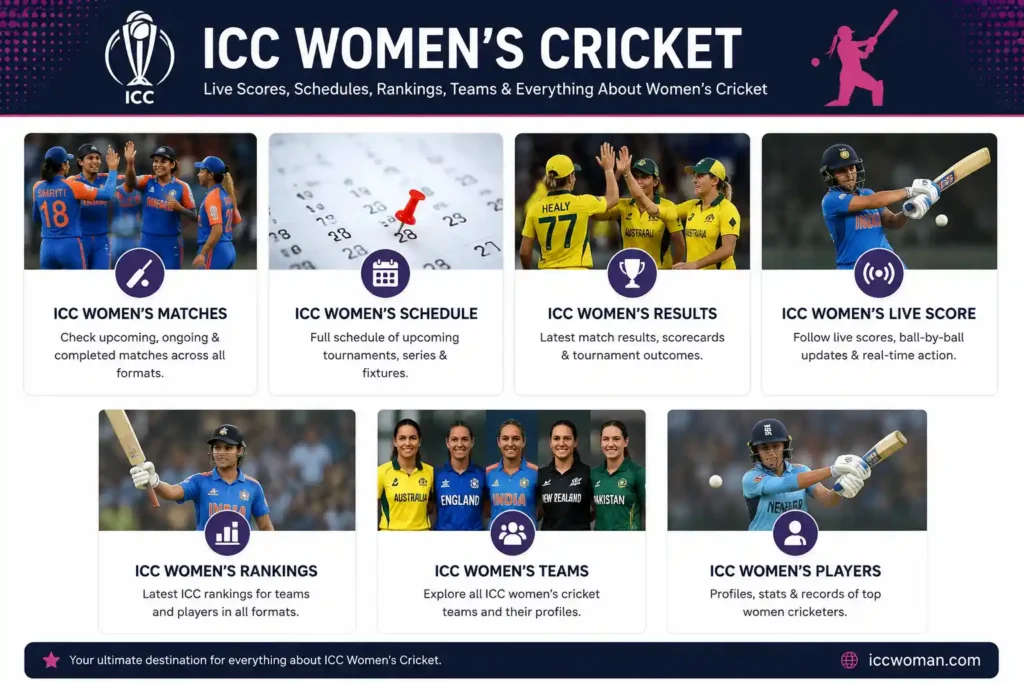
- ICC Women’s Matches — how matches work across formats, and today’s biggest fixtures
- ICC Women’s Schedule — how the international calendar is structured and where to find it
- ICC Women’s Results — recent results and how to keep track of outcomes
- ICC Women’s Live Score — where to follow ball-by-ball action as it happens
- ICC Women’s Rankings — how the ranking system works and who’s on top right now
- ICC Women’s Teams — every major nation, in one place
- ICC Women’s Players — the stars defining the sport right now
What Is ICC Women’s Cricket?
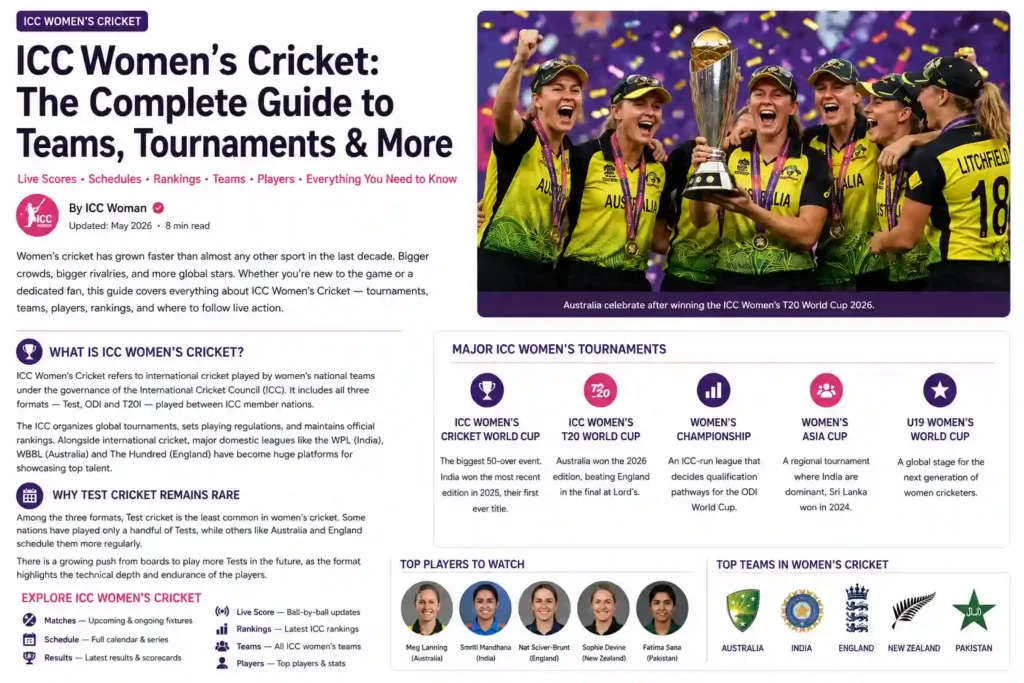
ICC Women’s Cricket refers to international cricket played by women’s national teams under the governance of the International Cricket Council, the sport’s global governing body. It covers all three formats of the game — Test cricket, One Day Internationals (ODIs) and Twenty20 Internationals (T20Is) — played between the national teams of ICC member nations, from long-established cricketing powers like Australia and England through to newer full members and associate nations still building their international programs.
The ICC oversees the major global events in the women’s game, sets playing regulations, and maintains the official player and team rankings that track form across all three formats. Alongside international cricket, a growing number of domestic franchise leagues — the Women’s Premier League in India, the Women’s Big Bash League in Australia, and The Hundred Women’s Competition in England — now sit alongside the international calendar as major fixtures in their own right, drawing many of the same international stars into club competition for several weeks each year.
Why Test Cricket Remains Rare
Of the three formats, Test cricket remains by far the least common in the women’s game. Where ODIs and T20Is are scheduled regularly across bilateral tours and major tournaments, Women’s Tests are still relatively infrequent — some nations, like Pakistan, have played only a handful across their entire international history, while others, including Australia and England, schedule them more consistently as part of ongoing rivalries like the Women’s Ashes. That scarcity means a Test win or a standout individual Test performance tends to carry outsized significance in the women’s game, precisely because the opportunities to achieve one come around so rarely compared to white-ball cricket.
There’s been a gradual push from several boards to schedule more Test cricket in recent years, driven partly by player advocacy and partly by a recognition that the format offers a different kind of showcase for the game’s technical depth. Whether that translates into a genuinely busier Test calendar in the coming years remains one of the more interesting structural questions facing the sport.
Major Competitions in Women’s Cricket
Several tournaments define the international calendar each cycle:
The ICC Women’s Cricket World Cup — the 50-over format’s biggest prize, held roughly every four years. India won the most recent edition in 2025, their first-ever title, beating South Africa in the final. Australia remain the tournament’s most successful side by a wide margin, with seven titles overall.
The ICC Women’s T20 World Cup — the sport’s flagship short-format event, also held on a roughly biennial cycle in recent years. Australia won the 2026 edition, beating hosts England in the final at Lord’s, extending their own record to seven T20 World Cup titles as well.
The Women’s Championship — an ICC-run league structure that determines qualification pathways for the ODI World Cup, giving context and stakes to bilateral ODI series between top-ranked nations outside of the World Cup itself.
The Women’s Asia Cup — a regional tournament contested primarily between South Asian nations, with India historically the dominant side, though Sri Lanka’s 2024 title win broke a long run of finals dominated by India and Pakistan.
The Commonwealth Games — women’s T20 cricket has featured at the Commonwealth Games in recent editions, adding another multi-sport stage to the international calendar.
The Women’s U19 World Cup — a newer addition to the global calendar, giving the sport’s next generation of stars a genuine global tournament of their own before stepping up to senior international cricket.
Beyond ICC events specifically, the three major domestic leagues have become genuine fixtures of the wider cricket calendar. We’ve covered each in detail: the Women’s Premier League, The Hundred Women’s Competition, and the Women’s Big Bash League each have their own format, history and list of champions worth knowing.
Matches, Schedule and Results
The international women’s calendar runs year-round, blending bilateral series between individual nations with the major ICC events described above. Bilateral tours — a team travelling to play a Test, ODI or T20I series against a single opponent — make up the bulk of the calendar between World Cups, while franchise league windows are increasingly blocked out on the calendar too, meaning a genuinely busy year for the sport’s top players across international and domestic commitments alike.
For the latest fixtures, results and schedules, our news section covers match reports and squad announcements from every major team as they happen. Keeping track of a specific team’s schedule is often the easiest way to follow the sport day to day, since it’s rare for every major nation to be playing at once outside of a global tournament window.
Understanding the Rankings
ICC rankings track form across Test, ODI and T20I cricket for both teams and individual players, updated weekly using a points system that weighs performance quality rather than simple win-loss records. We’ve broken down exactly how that system works, along with the sport’s biggest individual records, in our complete guide to women’s cricket rankings and records — essential reading if you want to understand why a team or player’s position can shift even without playing a match that week.
For the current standings themselves, our rankings page tracks where every ranked nation and player currently sits across all three formats.
The Teams
Ten nations currently hold ICC Women’s ODI status, with a wider pool of teams competing in T20I cricket following the format’s expansion to include every eligible ICC member. We’ve built detailed guides to several of the sport’s leading nations:
- India Women — 2025 ODI World Cup champions, led by Harmanpreet Kaur
- Australia Women — the sport’s most successful team, currently ranked No. 1 in both ODI and T20I cricket
- England Women — hosts and runners-up at the 2026 T20 World Cup
- South Africa Women — finalists at three ICC events in as many years
- Pakistan Women — led by all-rounder Fatima Sana, still chasing a first knockout-stage appearance at a global event
Each guide covers the team’s current squad, leadership, recent results and broader history — a good starting point whether you’re following a team for the first time or want the full context behind their current results.
The Players
Individual talent drives interest in the sport as much as team results do. We’ve profiled some of the players currently defining the international game, starting with Smriti Mandhana — India’s vice-captain, a two-time WPL-winning captain with Royal Challengers Bengaluru, and currently the top-ranked ODI batter in the world. More player profiles are being added regularly as we cover the sport’s biggest current stars in depth.
Beyond individual profiles, our rankings and records guide covers the statistical giants of the sport’s history — players like Mithali Raj, Jhulan Goswami and Ellyse Perry, whose records still define what greatness looks like in the women’s game even years after some of them have retired.
Live Scores and Following Matches in Real Time
For live scores during an active match, the official broadcaster in your region and major cricket statistics sites like ESPNcricinfo typically offer ball-by-ball coverage, updated scorecards and commentary as play happens. Our own coverage focuses on match reports, analysis and context once results are confirmed — the kind of deeper reading that complements live scoring rather than duplicating it, giving you the story behind a result rather than just the numbers as they land, so you can understand not just what happened but why it mattered.
Staying Up to Date
Given how packed the modern calendar has become — international bilateral series, three major domestic leagues, and a rotating cycle of ICC events — following every storyline in women’s cricket at once can be genuinely difficult even for dedicated fans. Our news section is built to make that easier, covering major results, squad news and standout individual performances across every major team and tournament in one place, rather than requiring you to track a dozen different sources separately.
Why Now Is a Good Time to Start Following
If you’re newer to women’s cricket, there’s genuinely no better moment to start paying attention. The last few years alone have produced India’s first-ever World Cup title, a genuinely open field at the top of both major format rankings, and three different major domestic leagues all drawing world-class talent and growing crowds. Rivalries that used to be one-sided — India versus Australia, England versus Australia, South Africa’s rapid rise up the rankings — have become genuinely competitive, and that competitiveness is exactly what makes a sport worth following closely rather than just checking in on once every World Cup.
Whether your interest is in a specific team, a favourite player, or simply following the biggest global tournaments as they happen, the resources on this site are built to give you the full picture — not just what happened, but why it matters and where things are heading next.
Frequently Asked Questions
What does ICC stand for in women’s cricket? The International Cricket Council, the global governing body that oversees international cricket, including all major women’s tournaments and the official player and team rankings.
What are the biggest tournaments in women’s cricket? The ICC Women’s Cricket World Cup (ODI format) and the ICC Women’s T20 World Cup are the two biggest global events, alongside the Women’s Championship qualification structure, the Women’s Asia Cup, and major domestic leagues like the WPL, WBBL and The Hundred Women.
How many teams play ICC Women’s ODI cricket? Ten nations currently hold ODI status, with a much wider pool of teams competing in T20I cricket following the format’s broader expansion across ICC membership.
Who is currently ranked No. 1 in women’s cricket? Australia currently top both the ICC Women’s ODI and Women’s T20I team rankings. Individual player rankings vary by format and update weekly — check our rankings page for the current standings.
Where can I find live scores for women’s cricket matches? Official broadcasters in your region and major cricket statistics sites typically provide live ball-by-ball scoring during active matches. Our coverage focuses on match reports and analysis once results are confirmed.
How often is the Women’s Cricket World Cup held? Roughly every four years for the ODI format, with the T20 World Cup generally following a shorter, more frequent cycle in recent years.
What’s the difference between the three major domestic leagues? The WPL (India) and WBBL (Australia) both use a standard T20 format, while The Hundred Women’s Competition (England) uses a distinct 100-ball format. All three run on their own annual schedule and draw a mix of domestic and international players.
Do international players compete in more than one domestic league? Yes — many of the sport’s top players feature across multiple leagues each year, alongside their national team commitments, giving fans regular opportunities to watch the same stars in different competitions throughout the calendar.
Whatever brings you to women’s cricket — a favourite team, a standout player, or simply curiosity about a sport that’s growing faster than almost any other right now — there’s genuinely more good cricket being played, across more competitions, than at any previous point in the sport’s history. That depth is exactly what makes it worth following closely rather than checking in only once every World Cup cycle.